Well report No. RR-8354 · T2N · R43W · SEC 14 · filed September 30, 2026
Midstream & PipelinesWell report
Attack on Saudi Pipeline Puts Gasoline Prices Back in Focus
Deutsche Welle reports an attack on a Saudi oil pipeline could lift global gasoline prices. The price effect remains attributed analysis pending operator data on volumes and repair timing.
Field notes
- Deutsche Welle reported that an attack on a Saudi oil pipeline could raise global gasoline prices.
- The report frames the price effect as a risk, not a confirmed increase, and does not specify the pipeline, affected volumes, or repair timeline.
- Market impact hinges on operator confirmation of any throughput loss and the crude benchmarks' response to firm outage data.
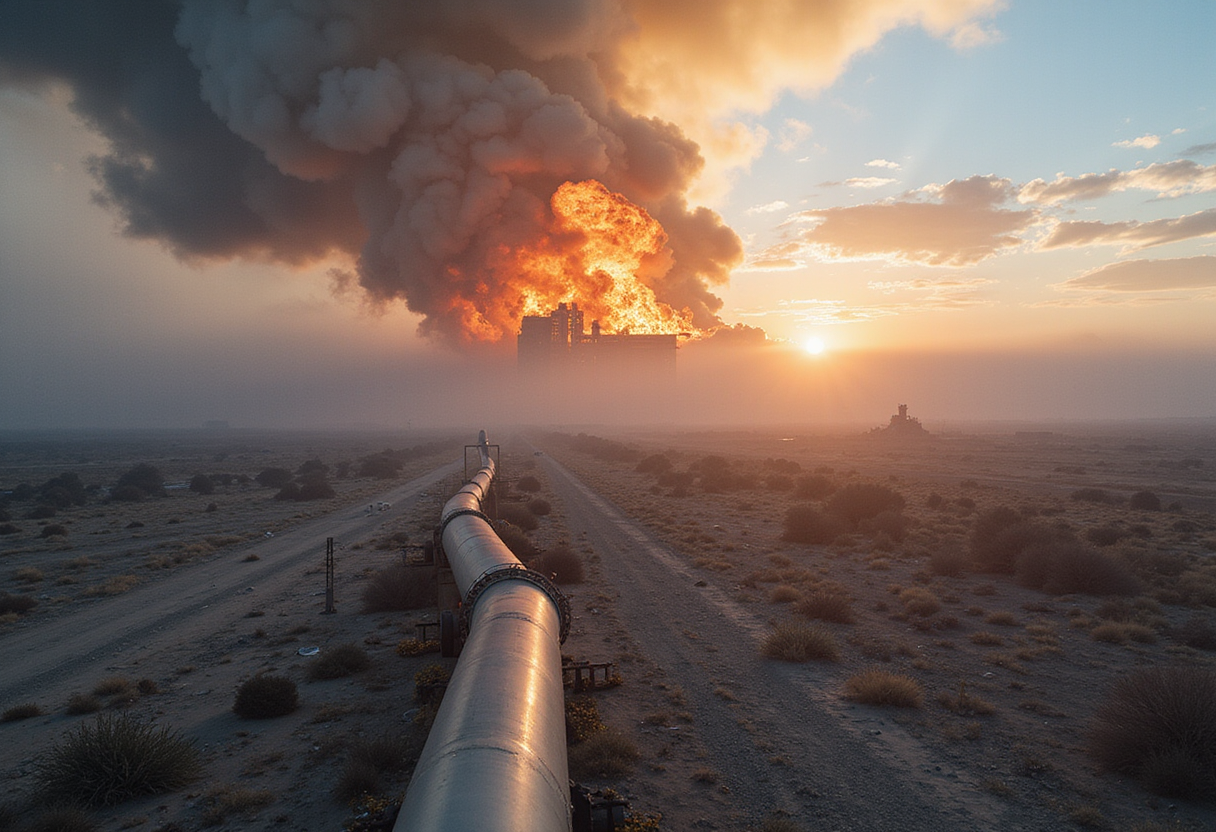
An attack on a Saudi oil pipeline has revived the question that follows every strike on the Kingdom's hydrocarbon infrastructure: how much of the disruption reaches the global driver at the pump.
Germany's international broadcaster Deutsche Welle reported that the incident could push global gasoline prices higher. The report treats the price effect as a risk rather than a settled outcome, and that framing matters for anyone tracking crude and product markets in the wake of attacks on Saudi energy assets.
Saudi Arabia sits at the center of the world's exported-barrel trade. The Kingdom moves crude through a network of pipelines, processing facilities and export terminals on the Gulf coast, and any strike that touches that chain forces traders, refiners and retailers to reprice the security premium embedded in every barrel. How much of the premium sticks depends on what was hit, how quickly operator Saudi Aramco can restore flows, and whether spare capacity elsewhere can cover the gap.
The Deutsche Welle report does not specify the pipeline involved, the volume affected, or the timeline for any repair. Those are the numbers the market will wait for. Until the operator or the Saudi government confirms the operational impact, the price response rests on expectation rather than measured outage.
For downstream watchers, the transmission path from a pipeline strike to a gasoline price is not direct. Crude disrupted at the wellhead or in transit must first tighten export availability, then lift benchmark prices, then squeeze refinery margins, and only then pass through to retail pumps — a chain that can take weeks and can break at any link if inventories buffer the shock. OECD stocks, refinery run rates and freight availability all sit between the attack and the motorist.
That has not stopped markets from reacting to Saudi infrastructure incidents before. Attacks on the Kingdom's energy network have historically triggered immediate risk premia in crude benchmarks, with Brent and WTI both sensitive to headlines from the region even when physical flows remain largely intact. Product markets follow crude, though with a lag and with their own seasonal pressures layered on top.
Saudi Arabia's role as the swing supplier within OPEC amplifies the effect of any strike. The Kingdom holds most of the world's advertised spare production capacity, and that capacity is itself concentrated in a limited number of fields, pipelines and terminals. An outage in the system that moves those barrels to market reduces not just current supply but the buffer that reassures buyers during any other disruption — geopolitical or otherwise.
Deutsche Welle frames the gasoline-price risk in global terms, and the exposure is genuinely global. Refineries in Asia, Europe and North America all price against benchmarks influenced by Gulf crude flows. Retail markets with high fuel taxes absorb crude moves more slowly; markets where the pump price tracks crude more directly pass them through faster. Consumers in the latter categories would notice any sustained rise first.
What the report does not claim is equally important. It does not state that gasoline prices have already risen, nor that a specific increase is locked in. The conditional — could raise — places the price effect firmly in the category of analyst expectation, not recorded market data.
For the trade, the operative questions now are operational. Which pipeline segment was struck, and what throughput did it carry? Has Saudi Aramco confirmed any reduction in flows, and can the operator reroute volumes around the damaged section? What do tanker-tracking data and loading schedules at Gulf export terminals show in the days ahead?
The watch items are concrete: an operational statement from the pipeline operator on volumes and repair timing, the next batch of weekly inventory data from consumer economies, and the crude benchmarks' response once the first firm outage figures — if any — reach the market. Until then, the gasoline-price risk stands as attributed analysis, and the premium priced into crude remains a judgment call rather than a number.
via Google News: Pipelines and midstream (Source)
More from Elena Vasquez
Adjoining reports
- Crude Trims Advance as Saudi Pipeline Returns to Service
- Oil retreats from highs on reports Saudi pipeline ramping back up
- Crude Slips as Saudi Arabia Raises Pipeline Throughput
- Saudi Arabia Restarts Crude Flows on Key Pipeline After Attack
- Oil Slips as Saudi Arabia Offers Extra Crude via Hormuz After Attack