Well report No. RR-4933 · T15N · R11W · SEC 3 · filed October 1, 2026
Midstream & PipelinesWell report
Egypt Targets Midstream Emissions Cuts as Gas Output Push Accelerates
Dahshour's 24 MW waste-heat recovery and GASCO's 1.5 bcf/d Western Desert upgrade anchor Egypt's push to cut midstream emissions while restoring gas throughput.
Field notes
- EGAS reported nine new development projects, 28 wells added, and $1.12 billion in investment in 2026.
- GASCO's Western Desert Gas Complex upgrade lifted processing capacity to 1.5 billion cubic feet per day; Dahshour compressor expansion adds 18 mmcm/d plus 24 MW of waste-heat recovery.
- Egypt's updated NDC targets a 65% cut in oil and gas sector GHG emissions by 2030 versus business as usual; World Bank data show flaring fell from 2.7 bcm in 2012 to 2.0 bcm in 2022.
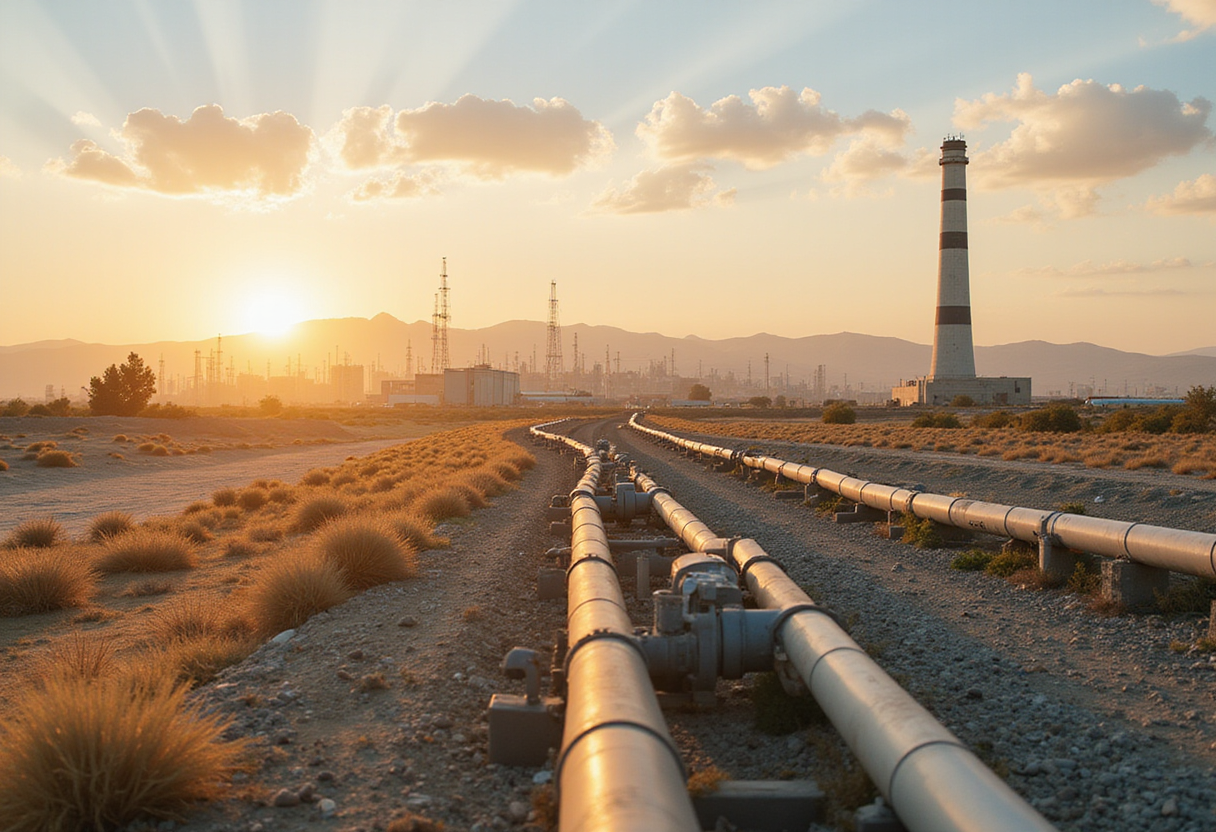
Egypt's gas midstream — the gathering systems, treatment plants, compressor stations, pipelines and LNG infrastructure that carry hydrocarbons from field to market — has become the focal point of the country's decarbonization effort, and the numbers driving it are already on the table: nine new development projects, 28 wells added, and $1.12 billion invested in 2026, according to EGAS.
The Ministry of Petroleum has stressed faster field development and integration into existing infrastructure as the government works to close the natural gas supply-demand gap. Since early 2026, announcements of new exploration projects have come more frequently as Egypt fast-tracks upstream activity to restore production and reinforce its position as a regional energy hub.
Two projects illustrate how the country is adding throughput while managing emissions. Fayoum North-4, a West Delta well brought online in August 2026, adds roughly 80 million cubic feet per day of natural gas through the existing Giza-Fayoum pipeline — a field-to-market tie-in that concentrates new production on established infrastructure rather than duplicating it.
The second is brownfield. GASCO's upgrade of the Western Desert Gas Complex lifted processing capacity to 1.5 billion cubic feet per day, demonstrating how retrofitting existing facilities can add value without new greenfield footprint. Brownfield expansion, analysts note, requires careful project screening: retrofit costs, operating expenses, remaining asset life, and emissions performance must be weighed against the footprint of a new build.
Dahshour sets the template
The national transmission system is also being modernized with efficiency in mind. GASCO moved about 2.3 trillion cubic feet of gas through the grid in 2025. At the Dahshour compressor station, two new units under construction will add 18 million cubic meters per day of capacity. The project includes waste-heat recovery technology expected to generate around 24 megawatts of electricity without burning additional fuel — a template for how midstream upgrades can support lower-carbon downstream operations.
Future projects may go further, adopting variable-speed drives, advanced controls, electrification, and efficient utilities. Where electricity increasingly comes from lower-carbon sources, electrification can also cut the direct fuel consumption associated with some midstream operations.
Flaring and methane: the near-term wins
Egypt's updated Nationally Determined Contribution targets a 65% reduction in greenhouse gas emissions from the oil and gas sector by 2030 compared with business as usual, with associated-gas recovery identified as a key mitigation measure. Recovered gas can be directed to processing to yield natural gas, LPG, and condensates — turning an emissions liability into product.
The country has already made progress. World Bank data show gas flaring fell from 2.7 billion cubic meters in 2012 to 2.0 bcm in 2022, indicating remaining scope for flare-gas recovery infrastructure.
Methane leak detection and repair can complement that investment. Methane escapes through valves, compressors, pipelines, tanks, and other equipment, and operators can increasingly deploy satellite observations, infrared cameras, and continuous monitoring systems to identify emission sources and prioritize maintenance, depending on facility requirements.
Measurement is becoming institutional. The International Monetary Fund reported in 2026 that Egypt is developing a measurement, reporting, and verification framework covering flaring, fugitive methane, and vented methane emissions at the operator or project level. Consistent measurement would provide the data needed to identify high-emitting assets, evaluate mitigation projects, and track progress against targets.
Beyond compression, gas conditioning and treatment placed closer to producing fields can ease pipeline tie-ins and optimize how hydrocarbons move into the established national network. The objective is not simply more processing capacity, but optimizing where gathering, separation, compression, and treatment occur so resources move efficiently from producing assets to market.
The hurdles
Decarbonizing the midstream faces technical, commercial, and institutional constraints. Many gathering lines, compressor stations, and processing trains were designed for throughput, not low emissions; retrofits to cut methane leaks, electrify compression, or add waste-heat recovery can be complex and costly, and each project must weigh retrofit capex against remaining asset life and expected efficiency gains.
Commercially, midstream assets link multiple operators and contracts. Aligning incentives for leak detection, gas capture instead of flaring, and shared upgrades requires clear commercial terms and coordinated scheduling. Financing is another constraint: lenders and investors need predictable regulatory signals, robust emissions baselines, and measurable outcomes before underwriting performance-linked or blended finance. Capacity gaps in local engineering, leak detection and repair deployment, and supply chains could slow rollout unless paired with training and procurement strategies.
The near-term opportunities, however, are concrete. Targeted compressor electrification, control-system modernization, additional processing trains, and waste-heat recovery can deliver rapid emissions and fuel-use reductions at lower capital and land cost than greenfield builds — the Dahshour expansion and the Western Desert Gas Complex upgrade both demonstrate the approach. Systematic methane detection using satellites, drones, and continuous monitors can quickly find the largest leaks and convert lost gas into revenue. Connecting new wells to existing pipelines and plants, as with Fayoum North-4, concentrates emissions-reduction effort on fewer nodes.
Scaling these gains, industry voices argue, requires project-level economic screening that includes emissions performance, stronger regulatory and commercial frameworks that reward lower carbon intensity, and blended financing that bridges retrofit costs — measures that together would make green downstream upgrades the default rather than the exception.
The watch item: whether Egypt's MRV framework, still in development, delivers the operator-level emissions baselines that financiers and regulators need — and whether the next round of development projects, after 2026's nine sanctioned additions, carries emissions performance into project economics.
via Google News: Pipelines and midstream (Source)
More from James Calloway
Show full bio
Staff writer covering industry trends and analytics at Rig & Refinery.
117 articles
Adjoining reports
- Senegal Courts Turkish Partners for Up to $3.5 Billion Refinery Plan
- Dangote Teams With Ethiopia, Djibouti on $600 Million Fuel Pipeline
- Dangote Refinery, Turkana Oil Equipment Landed at Kenyan Ports
- Ethiopia, Djibouti and Dangote Commit to $660 Million Petroleum Pipeline
- TotalEnergies, AMNI Sanction Nigeria's Ima Gas Field at 60,000 boepd