Well report No. RR-2679 · T19N · R31W · SEC 7 · filed October 10, 2026
Midstream & PipelinesWell report
Iraq-Syria Crude Pipeline Construction May Begin in Q1 2027
Construction of a long-discussed Iraq-Syria crude oil pipeline "may begin" in Q1 2027, an official said this week. The announcement disclosed no throughput, route, operator or financing details.
Field notes
- An unnamed official said Iraq-Syria pipeline work 'may begin' in Q1 2027.
- No throughput, route, operator, cost or financing details were disclosed in the announcement.
- The historical 1930s Kirkuk–Baniyas line moved up to 300,000 bpd before halting in 2012.
- The Iraq-Turkey pipeline has faced repeated shutdowns since 2023 over arbitration and payment disputes.
- Syria was readmitted to the Arab League in 2023, with regional states re-engaging Damascus on energy.
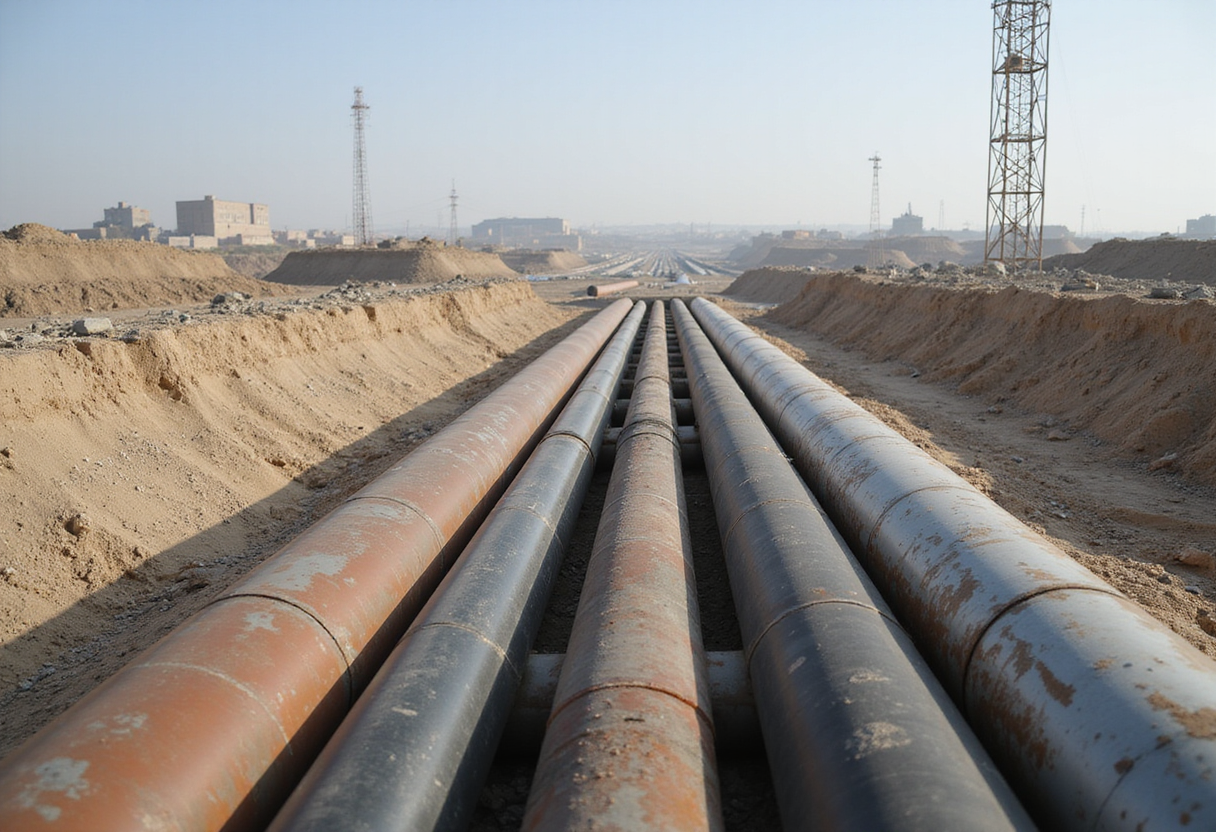
Construction of a long-discussed crude oil pipeline linking Iraq with Syria "may begin" in the first quarter of 2027, an official said in remarks reported this week. The statement, carried by regional outlets, gave no throughput figure, no routing detail and no operator name.
The conditional language frames the timeline as political intent rather than a sanctioned engineering schedule. A Q1 2027 start would put pipeline work at least fifteen years after the previous Iraq–Syria export corridor effectively went dark.
What does the announcement actually say?
Almost nothing beyond the timing. The official did not disclose:
- Pipeline diameter and throughput
- Source field in Iraq
- Receiving terminal on Syria's coast
- Consortium composition
- Estimated cost
- Security framework for the border crossing
For comparison, the historical 1930s Kirkuk–Baniyas line ran roughly 800 km from northern Iraq to Syria's Tartus governorate and moved up to 300,000 bpd of light-sweet crude before flows halted in 2012 amid the Syrian civil war. The new corridor's configuration has not been disclosed.
The Kirkuk–Baniyas system has been the subject of revival talk on multiple occasions since 2012. Periodically, Iraqi and Syrian officials have referenced reopening the line, including after Damascus's readmission to the Arab League in 2023. None of those discussions produced a sanctioned construction program.
Why does the corridor matter for Iraqi exports?
Iraq's export options have narrowed over the past decade. The Iraq–Turkey pipeline, which historically carried Kirkuk crude to the Mediterranean at Ceyhan, has faced extended shutdowns since 2023 amid arbitration and payment disputes involving Baghdad, Ankara and the Kurdistan Regional Government. The bulk of Iraq's liftings now run through southern Gulf terminals at Basra.
A second Mediterranean route through Syria would give Iraqi producers an outlet that bypasses both Turkish territory and the Strait of Hormuz. It would also re-establish a corridor that, when last operated at scale, gave Iraqi crude a direct path to European refiners without any Hormuz exposure.
How does this fit Syria's regional reopening?
The announcement arrives against a backdrop of Syrian reintegration into the Arab diplomatic system. Saudi Arabia and several regional states have moved to re-engage with Damascus on reconstruction and energy since 2023.
Syrian crude production has run well below its pre-2011 peak of roughly 380,000 bpd, leaving spare capacity on Syrian pipelines and Mediterranean terminals. A new Iraq-Syria line would convert that spare capacity into transit revenue for Damascus.
What are the engineering and security hurdles?
Cross-border pipeline work of this length requires a stable security framework along the route, something that has been absent in eastern Syria for over a decade. Border governance between the Kurdistan Region, federal Iraq and Syrian territory remains unresolved in several sectors.
Financing will also require a sovereign guarantor or committed offtaker, since most international lenders and contractors have avoided Syria under continuing sanctions programs. Until those constraints are addressed, no FEED or EPC contract can move forward.
What would change for refiners?
For Mediterranean refiners, additional Iraqi light-sweet crude landing on Syria's coast would compete directly with North Sea Forties, Azeri BTC, and Russian Urals barrels. That could compress the light-sweet differential, particularly if Iraqi exports exceed 200,000 bpd through the new route.
For Iraqi producers, the corridor would offer pricing optionality away from Gulf sour benchmarks and a sell-direct path into the Mediterranean spot market.
What is the watch item?
The Q1 2027 target uses "may," not "will." Three triggers would convert this from political signal to project: a signed bilateral MoU between Baghdad and Damascus, an FEED or EPC contractor award, and a disclosed throughput and routing announcement.
The earliest meaningful data point will be the next official bilateral meeting between the Iraqi and Syrian energy ministries. Until then, this remains a project at the political stage, not at the procurement stage.
via Google News: Pipelines and midstream (Source)
More from Priya Raman
Show full bio
Senior reporter covering media and advertising at Rig & Refinery.
381 articles