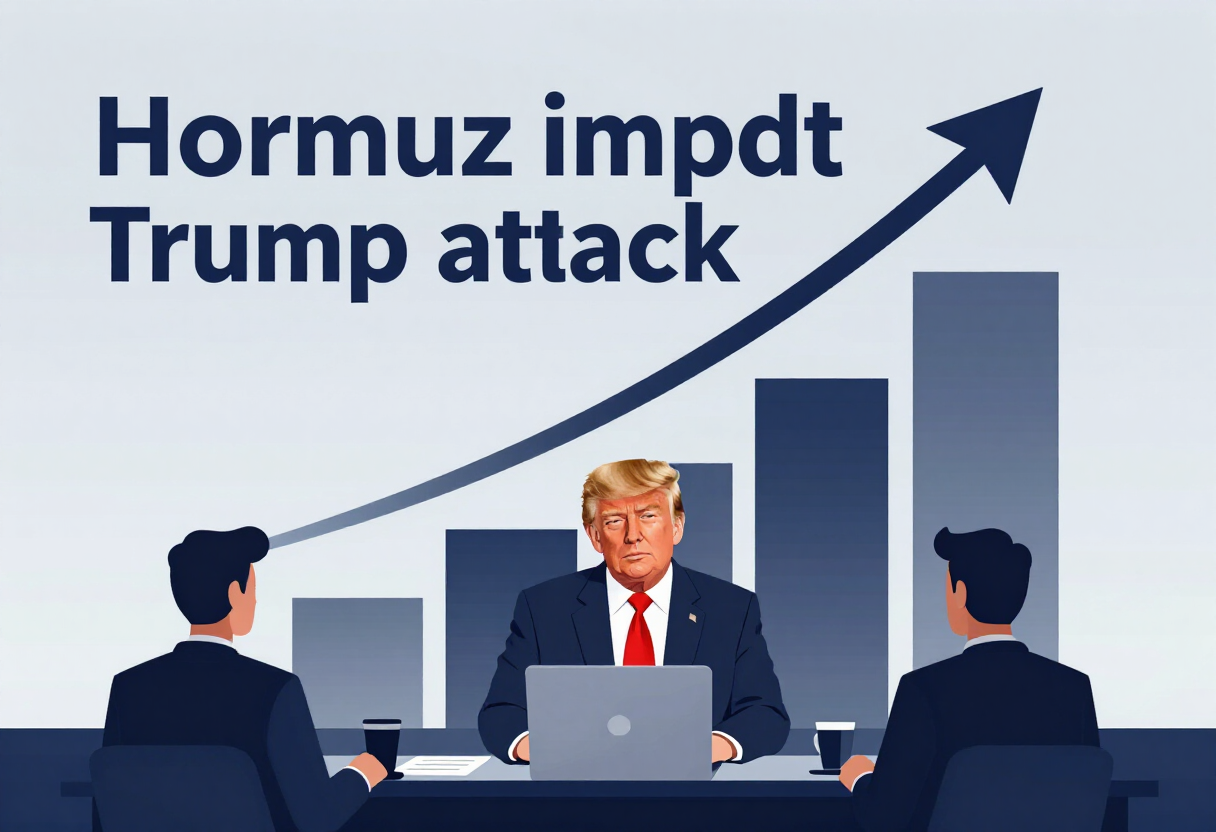
Oil Prices Climb as Hormuz Standoff and Trump Attack Threat Weigh
Oil futures gained as an impasse over the Strait of Hormuz combined with an attack threat from Donald Trump to lift the geopolitical risk premium on crude.
TAG C-9416 · 535 words on the permit
Scope of work
- Oil prices rose in the session covered by Al-Monitor's report.
- Two cited drivers: a Strait of Hormuz impasse and an attack threat from Donald Trump.
- The headline did not specify the size of the price move, benchmark, or target of the threat.
Oil prices moved higher as two risk premiums converged on the market at once: an unresolved impasse over the Strait of Hormuz and a threat of attack leveled by former US President Donald Trump.
The Hormuz channel remains the single most consequential chokepoint for crude traders. Roughly a fifth of the world's oil supply transits the waterway, and any sustained disruption — or credible threat of one — reprices freight, insurance, and benchmark crude in short order. Monday's session reflected exactly that arithmetic.
Al-Monitor reported the gain under the headline "Oil rises amid Hormuz impasse, Trump attack threat," capturing the twin drivers now dominating trading desks: stalled maneuvering over the strait and the political rhetoric coming out of Washington.
What the headline tells us — and what it doesn't
The source material available for this item is limited to the headline itself, and Rig & Refinery readers should treat the details accordingly. What can be established from it:
- Direction: Oil rose.
- Driver one: An impasse concerning the Strait of Hormuz.
- Driver two: A threat of attack attributed to Trump.
What the headline does not specify is the size of the move, the contract month, the benchmark involved, or the identity of any target of the threatened attack. Traders should await full session data before repricing risk models.
Why Hormuz still anchors the risk premium
The Strait of Hormuz connects the Persian Gulf to the Gulf of Oman and the Arabian Sea. Saudi Arabia, the UAE, Iran, Iraq, Kuwait, Qatar, and Bahrain all move crude, condensate, or LNG through it. There is no bypass of comparable scale — the Saudi East-West pipeline and the UAE's Fujairah route offset only a fraction of tanker volumes.
That asymmetry is why an "impasse" — a word implying stalled negotiation or standoff rather than active hostilities — is sufficient to lift prices on its own. Market participants price the tail risk of closure, not the base case.
The Trump factor
The second driver named in the headline is an attack threat from Trump. Political rhetoric from current or former US presidents has historically moved crude within minutes when it touches Middle East military action, and traders responded in kind here.
Attribution matters on this point: the threat is Trump's commentary, and the market's reaction to it is the story — not any confirmation that an attack is planned or imminent. Rig & Refinery treats such statements as sentiment drivers until an operational fact — troop movements, carrier group repositioning, tanker tracking anomalies — backs them.
What downstream should watch
For refiners, a Hormuz-driven premium raises delivered crude cost for Gulf-dependent buyers in Asia well before it touches Atlantic-basin refiners running WTI or Brent-linked grades. Freight and war-risk insurance on Gulf routes typically reprice first, then physical differentials, then paper.
The watch items from here:
- Whether the Hormuz impasse produces any concrete shipping disruption — the next tanker tracking and insurance-rate data will signal it before official statements do.
- Whether the Trump attack threat converts into actionable US military posture, or remains rhetoric.
- How OPEC+ spare capacity framing shifts if the premium persists into subsequent sessions — the producer group's next scheduled decision remains the calendar anchor for supply.
via Google News: Pipelines and midstream (Source)
More from Daniel Okafor
Show full bio
Market editor covering consumer brands and retail at Rig & Refinery.
52 articles
Linked permits
- T-9679
- E-6808
- V-6414
- P-3515
- E-3064