Well report No. RR-2936 · T22N · R9W · SEC 34 · filed October 2, 2026
Midstream & PipelinesWell report
Ottawa Designates 1 Million bpd Pacific Link Pipeline in National Interest
Ottawa fast-tracks the 1 million bpd Pacific Link pipeline from Bruderheim to a Delta, B.C. deepwater port, with MPO conditions due Sept. 1, 2027 and CER hearings still ahead.
Field notes
- Pacific Link would carry roughly 1 million bpd of crude about 1,250 km from Bruderheim, Alta., to a deepwater port outside Delta, B.C., for tanker export to Asia.
- Expected ownership: Trans Mountain Corporation, the Alberta Petroleum Marketing Commission and Pembina Pipeline Corporation, with a minimum 10 per cent Indigenous equity.
- The Major Projects Office is expected to issue the project's conditions document by Sept. 1, 2027, after MPO review and Canada Energy Regulator public hearings.
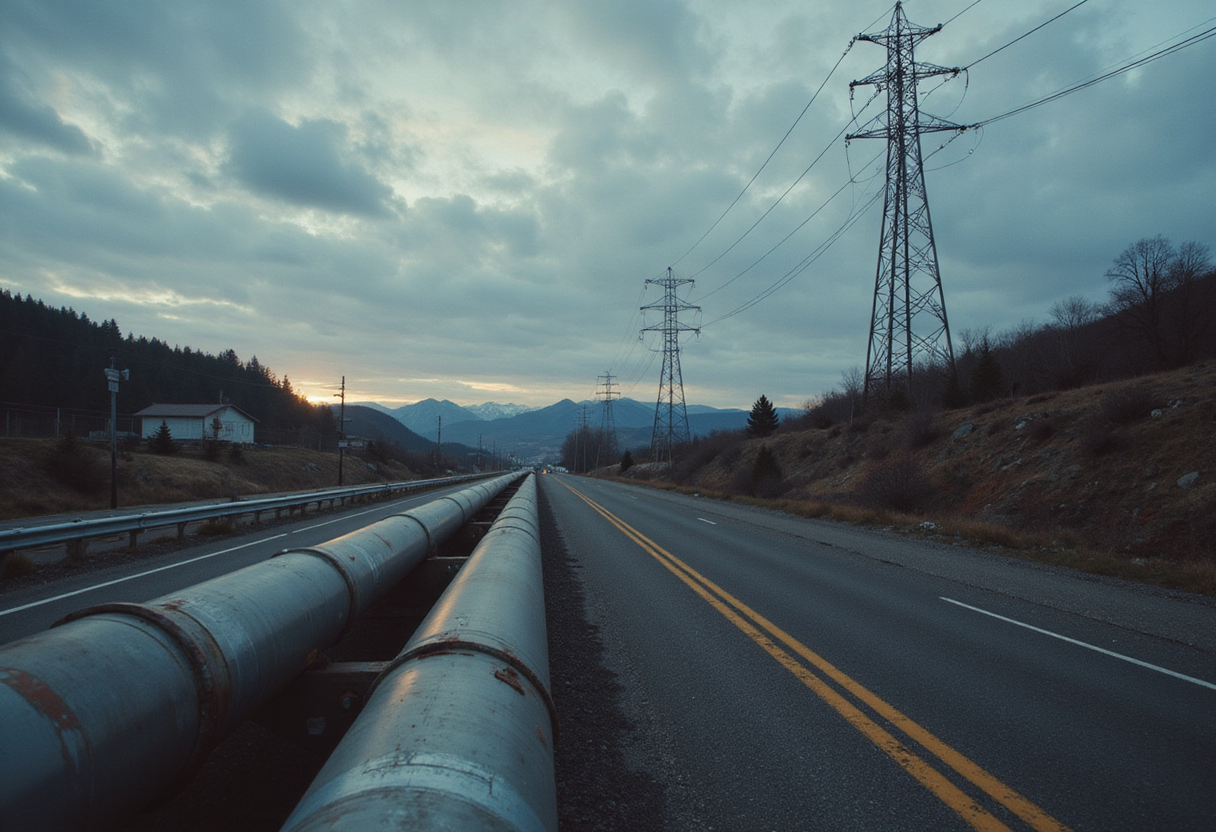
A 1,250-km pipeline designed to move roughly one million barrels per day of Canadian crude from Bruderheim, Alta., to a deepwater port outside Delta, B.C., has been designated a project in the "national interest" by the federal government — the first step in a fast-tracked approval process that Ottawa says will produce a conditions document by Sept. 1, 2027.
Prime Minister Mark Carney announced the designation Thursday in Fort McMurray, flanked by Alberta Premier Danielle Smith. The project, now named Pacific Link, would be jointly owned by Trans Mountain Corporation (TMC), the Alberta Petroleum Marketing Commission (APMC), and Pembina Pipeline Corporation, with a minimum 10 per cent equity offered to Indigenous peoples.
The national-interest designation routes Pacific Link through Carney's Major Projects Office (MPO), the federal branch created to compress approval timelines for large economic initiatives. The designation does not sanction the project. Pacific Link still faces an MPO regulatory review and public hearings led by the Canada Energy Regulator before the government issues its conditions document, which will set out requirements for the proponents.
The capacity math
The throughput target is significant against Canada's existing export base. Carney said 90 per cent of Alberta's oil currently goes to the U.S., and that Pacific Link would "materially reduce that dependence by allowing us to export an additional one million barrels a day to growing markets in Asia." Crude delivered to the Delta-area port would load onto large tankers for export.
A TD Economics report released this summer estimated the pipeline would boost Canadian oil exports by 20 per cent and more than double current tanker shipments to Asia.
"We have to do this, because the world is facing an energy crisis on three dimensions," Carney said, citing affordability and hydrocarbon availability, energy security, and climate change. He said oil demand is expected to "continue to be significant for decades to come, even under any plausible net zero scenario," and framed Canada as a candidate trusted supplier in a market made more volatile by the U.S. war against Iran.
"That means more customers, more choice, and higher prices for all Canadian energy producers," Carney said.
Sanctioned versus speculative
No proponent has sanctioned Pacific Link, and no capital cost figure was disclosed at the announcement. What Ottawa has delivered is a regulatory pathway, not a final investment decision. The ownership structure — TMC, APMC and Pembina — remains an expectation, and the MPO conditions document is not due for more than two years.
Lance Mortlock, managing partner of EY's energy market segment and a University of Calgary associate professor, called the project a major test of Canada's new major projects strategy and its ability to deliver regulatory certainty and predictable timelines.
"It's signals that we want to build again," Mortlock said. "Markets will be watching less for the announcement itself, but more whether governments can now deliver that regulatory certainty, clearer timelines, and more predictable investment conditions. So now that process starts."
"Resource wealth is only valuable if you can actually reach markets," he added. "We've got all this resource wealth across this great country, but if we can't get it to market, it's not worth the wealth that we talk about."
Mortlock predicted the announcement would unlock incremental oil sands capital, though not at the scale of the last decade's mine builds. "Do I think that we're going to see the mega mines that we saw 10 years ago? Probably not. But do I think we're going to see 150,000, 200,000-barrel-a-day in situ expansion? Yeah, for sure," he said, referring to steam-driven operations with a smaller footprint.
Political exposure
The project carries political risk on multiple fronts. NDP Leader Avi Lewis criticized the government for committing public money to a pipeline during the climate crisis and suggested the project would face legal challenges making it "not worth the risk." Conservatives took the opposite line: natural resources critic Carole Anstey said her party supports the pipeline but noted the announcement did not put "shovels in the ground" and urged the government to move at the speed Carney promised.
Carney attempted to pre-empt some of that exposure Wednesday, announcing $1.2 billion in federal funding for ocean protection projects in B.C., where he has also backed proposed expansion of the Port of Vancouver.
Industry has welcomed Ottawa's moves to simplify the regulatory process, roll back Trudeau-era environmental policies and strengthen tax incentives for new investment. Producers have shied away from big-ticket extraction spending in recent years, partly because of pipeline capacity constraints to tidewater; smaller-scale, shorter-term expansions toward the U.S. and West Coast are currently in the works.
The watch item
The Sept. 1, 2027 deadline for the MPO conditions document is the first hard date in the Pacific Link schedule. Between now and then sit the CER public hearings, Indigenous equity participation terms, and any legal challenges. As Mortlock put it: "The risk is that Canada proves it can announce faster than it can deliver. So what we need to do now is back it up to say, 'we can announce fast — but we can deliver fast too.'"
via globalnews.ca (Original)
More from Elena Vasquez
Adjoining reports
- Ottawa Designates One-Million-bpd Pacific Link Pipeline as First National-Interest Project
- Canada Designates 1 Million bpd Pacific Link Pipeline as National Interest Project
- Canada Designates Pacific Link Pipeline as National Interest Project
- Ottawa Lists Pacific Link Pipeline as Project of National Interest
- Canada Clears Pacific Link Pipeline for Single-Review Track