Well report No. RR-2796 · T16N · R34W · SEC 28 · filed October 12, 2026
Midstream & PipelinesWell report
Saudi Arabia Weighs East-West Pipeline Expansion to 10 Million bpd
Saudi Arabia is studying a boost of the East-West crude pipeline to 10 million bpd, per IndexBox — a proposal-stage move with Red Sea export and freight implications.
Field notes
- Saudi Arabia is considering raising East-West pipeline capacity to 10 million bpd, per an IndexBox report.
- The expansion is at proposal/study stage; no FID, contractor award or timeline has been announced.
- The pipeline links Eastern Province production to Red Sea export terminals at Yanbu, bypassing the Strait of Hormuz.
- A doubling of throughput capability would shift more Saudi loading to the Red Sea, affecting tanker routes and Gulf freight demand.
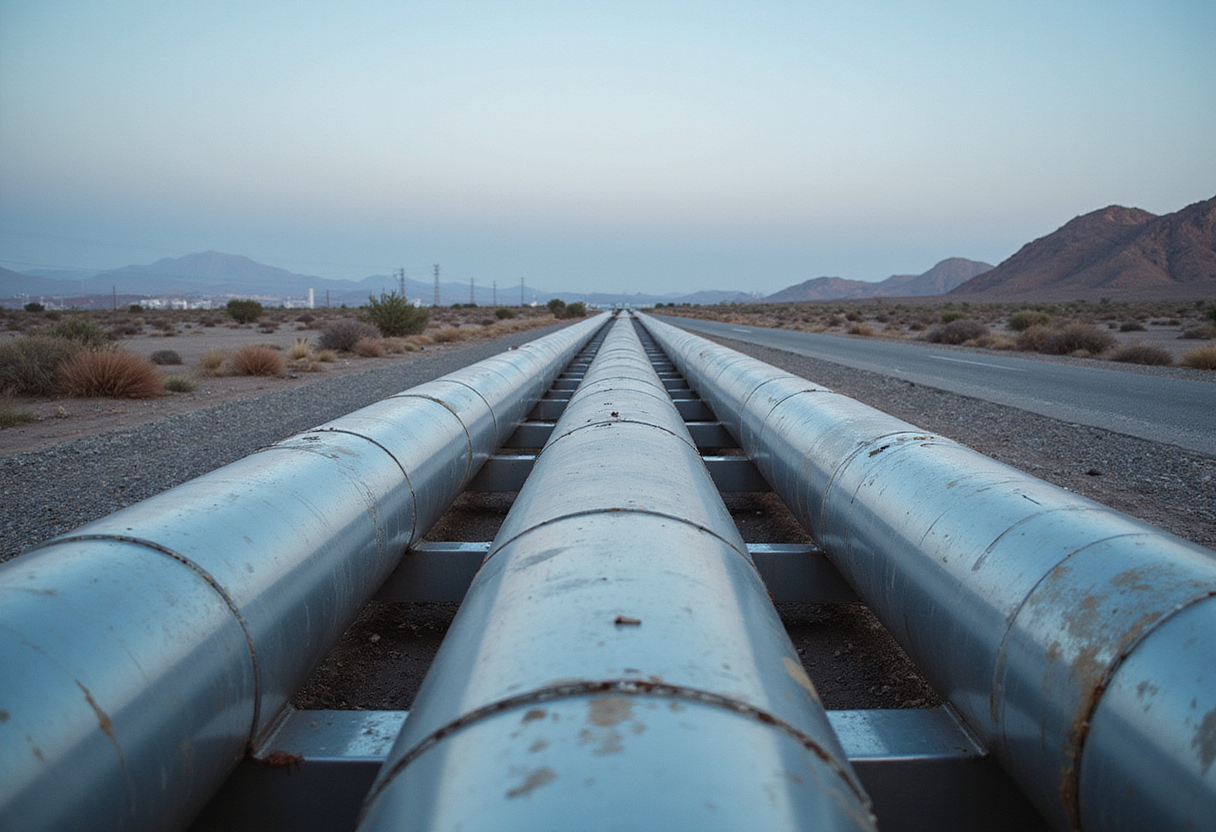
Saudi Arabia is considering raising the capacity of its East-West crude pipeline to 10 million bpd, according to a report carried by IndexBox — a number that, if sanctioned, would redraw the export math on one of the world's most consequential hydrocarbon routes.
The figure lands at a moment when Gulf producers are paying fresh attention to bypass routes around the Strait of Hormuz, and when Saudi export infrastructure decisions ripple straight into freight and crude slate planning from Rotterdam to Ningbo.
The East-West line — often referred to as the Petroline — runs roughly 1,200 km from the Eastern Province, heart of the kingdom's production at Ghawar and its neighbours, to Yanbu on the Red Sea. It exists so that Saudi crude can reach export markets without transiting Hormuz. Capacity talk in the 10-million-bpd range signals that Riyadh wants more of that optionality, not less.
IndexBox framed the plan as a proposal under consideration rather than an approved project, and that distinction matters. There is no final investment decision on the table in the reporting, no contractor awards, no timeline. What exists is a number — 10 million bpd — attached to a study.
What would a 10-million-bpd line actually mean?
The East-West pipeline's nameplate has historically sat around the 5-million-bpd mark, with Saudi Aramco having restored and tested capacity above that level in past years. A push toward 10 million bpd would, on paper, more than double the currently cited throughput ceiling.
For anyone planning refinery supply, that translates into a few practical stakes:
- More Saudi crude could load at Yanbu on the Red Sea rather than at Gulf terminals, shortening voyages to European and Atlantic-basin buyers.
- A larger bypass corridor would buffer exports against any Hormuz disruption — a scenario traders price in every time regional tension spikes.
- Tanker demand in the Gulf itself could soften if volumes shift west, while Red Sea and Suez transit volumes would climb.
Takeaway: this is an infrastructure play with a freight-market shadow, not just a pipeline story.
Sanctioned or speculative?
Trade-press discipline requires the split. Sanctioned: nothing, on the evidence of the report. Appraisal-stage: everything. The 10-million-bpd figure describes a capacity target under study, per IndexBox, and no Saudi official or Aramco statement confirming scope, cost or schedule appears in the reporting.
Saudi Aramco has not, in this material, put its name to the number. Until it does — through an FID, a contract notice, or a capital program disclosure — the expansion belongs in the same drawer as other big Middle East studies: real enough to plan around, not yet real enough to book.
That caution cuts both ways. Saudi decision-making on megaprojects has historically moved from study to steel faster than most peers, and the kingdom's stated intent to hold significant spare production capacity gives any debottlenecking of the westward route a strategic logic of its own.
Takeaway: the idea is credible; the project is not yet official.
Why the Red Sea route keeps gaining weight
Open the lens a little and the reasoning writes itself. A growing share of the world's crude still moves through Hormuz, and every Gulf producer has spent the past decade hedging that geography — pipelines across the UAE, proposals for overland routes, and in Saudi Arabia's case, a Petroline system that already exists and could be expanded at lower hurdle rates than a greenfield corridor.
Capacity on that system is, in effect, insurance. Analysts across the trade routinely treat west-coast loading flexibility as a premium asset for the kingdom, letting Aramco keep exports flowing under scenarios that would pin rivals inside the Gulf. Whether Riyadh prices that insurance high enough to fund a doubling is the question the study will answer.
Price commentary of that kind belongs to the desks, not to the fact pattern — IndexBox's item reports the consideration, not the economics.
Takeaway: geography is doing much of the arguing here.
The watch item
The signal to track is Aramco's own confirmation — an FID announcement, a capacity figure in company disclosure, or a construction award tied to the East-West line. Until then, the 10 million bpd number is a study target with a serious address, and the startup date doesn't exist yet.
via Google News: Pipelines and midstream (Source)
More from Elena Vasquez
Show full bio
News editor covering technology and product news in Oil and gas industry operations and markets at Rig & Refinery.
393 articles
Adjoining reports
- Saudi East-West Pipeline Restored to 5.8 Million bpd
- Saudi Arabia Targets 10 Million bpd Pipeline Export Capacity
- Saudi East-West Pipeline Back at Roughly 3.5 Million BPD After Repairs
- Saudi Arabia Puts East-West Pipeline Throughput at 5.8 Million Bpd
- Saudi Arabia Eyes 10 Million bpd East-West Pipeline Capacity