Well report No. RR-6698 · T2N · R18W · SEC 14 · filed October 9, 2026
Midstream & PipelinesWell report
Saudi East-West Pipeline crude flows hit 5.8 MMbpd: minister
Saudi Arabia's East-West Pipeline is carrying 5.8 MMbpd of crude according to the kingdom's energy minister, a level that places the Red Sea export corridor at or near full system utilization.
Field notes
- East-West Pipeline throughput reached 5.8 MMbpd per Saudi energy minister
- The disclosure was reported by Pipeline and Gas Journal
- The pipeline links the Eastern Province to the Yanbu Red Sea export terminal
- The system has operated since the 1980s and has been progressively debottlenecked
- The 5.8 MMbpd rate aligns with widely reported nameplate capacity for the combined twin-line system
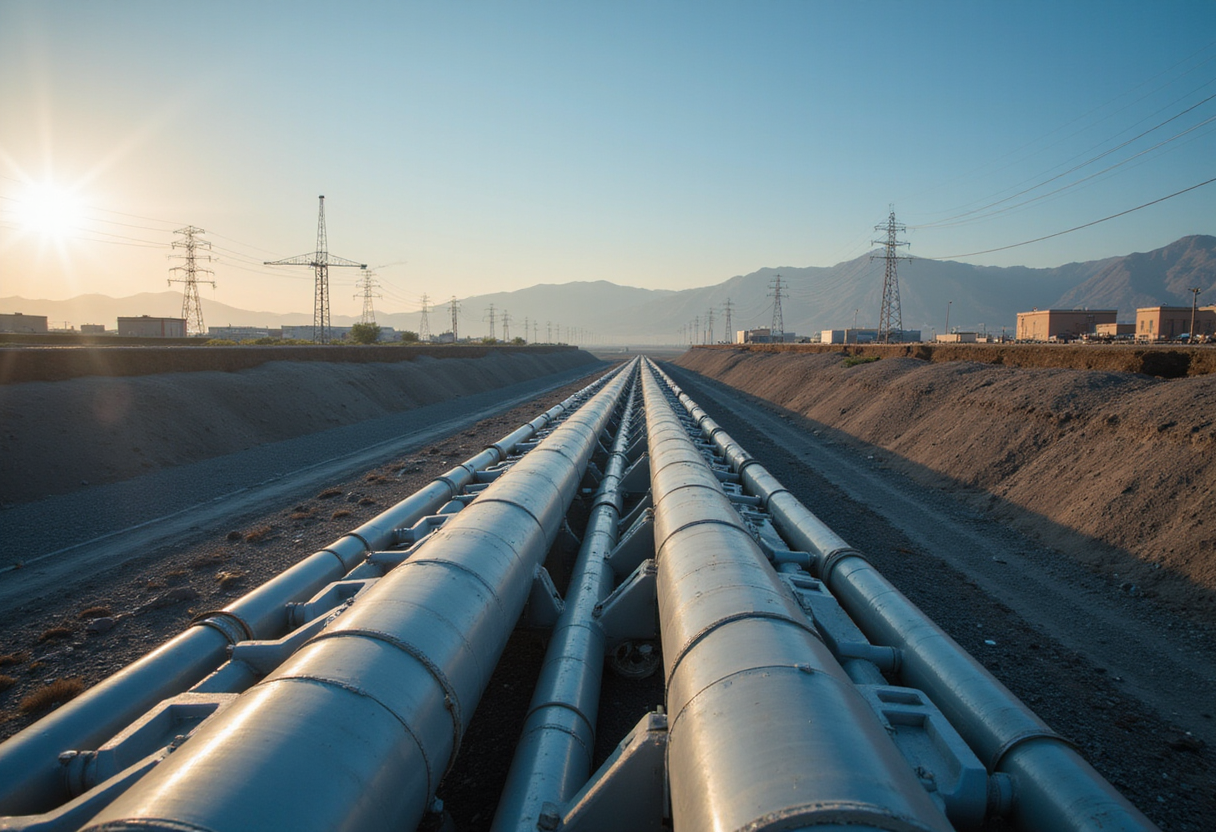
Saudi Arabia's East-West Pipeline is carrying 5.8 million barrels per day of crude, the kingdom's energy minister disclosed, a figure that places the strategic Red Sea export corridor at or near full system utilization.
The disclosure, carried by Pipeline and Gas Journal, does not specify the measurement window for the 5.8 MMbpd rate or whether it represents a single-day peak, a weekly average, or sustained operational throughput. The minister's statement nonetheless marks one of the highest publicly cited flow rates for the East-West system, which the kingdom's national oil company and its predecessor entities have operated since the 1980s.
The pipeline — also known as Petroline — links the Eastern Province oil hub to the Yanbu export terminal on the Red Sea coast, providing Saudi Arabia with a routing alternative to Gulf shipping through the Strait of Hormuz. The system was originally constructed as a strategic redundancy and has been progressively debottlenecked over subsequent decades, with additional pumping capacity, looping, and storage added at Yanbu to support higher throughput and a wider slate of crude grades.
At 5.8 MMbpd, the disclosed flow rate aligns with widely reported nameplate ranges for the combined twin-line system, suggesting the network is running close to its operating ceiling. The minister's statement carries no direct implication for OPEC+ policy, but it provides a real-time data point on Saudi export logistics at a moment when regional shipping security remains a watch item for buyers, refiners, and policymakers.
What is the East-West Pipeline's strategic role?
The pipeline offers Saudi Arabia routing optionality, allowing barrels to reach customers in Europe, the Mediterranean, and parts of Asia via Red Sea terminals without transiting the Strait of Hormuz. Sustained high utilization signals that Yanbu is functioning as a full alternative loading point, with implications for tanker demand on the Red Sea and Bab el-Mandeb route as well as for the economics of crude moving from Gulf to Red Sea destinations.
The pipeline's strategic value has only grown in periods when the Strait of Hormuz has faced security concerns or shipping disruption. By keeping the East-West system running at high rates, the kingdom maintains a continuous export channel for its crude that is independent of the Gulf chokepoint.
What does the throughput rate signal for Saudi production?
A 5.8 MMbpd flow on the East-West Pipeline does not equate one-for-one to Saudi total production, since the kingdom also loads from Gulf terminals at Ras Tanura and other Eastern Province facilities. The figure does, however, indicate that the kingdom is dispatching a large share of its export barrels through the western corridor at a time when voluntary production adjustments are in effect across the OPEC+ alliance.
For analysts tracking Saudi export volumes, the disclosure functions as a directional data point rather than a precise weekly figure. Independent tanker-tracking services, which monitor loadings at Yanbu, Ras Tanura, and other Saudi terminals, will provide the corroborating detail in their weekly flow reports.
How should traders and refiners read the disclosure?
The minister's figure is best treated as an operational benchmark rather than a precise export estimate. It tells the market that the East-West system is running near full capacity, but it leaves open the question of how long the rate is sustainable, what crude grades are moving, and how the flow splits between domestic and export demand.
The watch items for the weeks ahead are the next OPEC+ ministerial meeting, the next JODI oil data submission, and any update on Saudi Arabia's voluntary cut posture, all of which would directly affect East-West Pipeline throughput and the split of Saudi crude between Gulf and Red Sea loading points.
via Google News: Pipelines and midstream (Source)
More from Daniel Okafor
Show full bio
Market editor covering consumer brands and retail at Rig & Refinery.
144 articles
Adjoining reports
- Saudi East-West Pipeline Running at 50% as Crude Exports Resume
- Saudi Arabia's East-West Pipeline Resumes Crude Exports: Report
- Saudi East-West Line Carries Near 6 Million Bpd, Bloomberg Says
- Saudi Arabia Restores Oil Flows on East-West Pipeline
- Saudi East-West Pipeline Back Online at 40% of Pre-Attack Capacity