Well report No. RR-8704 · T6N · R35W · SEC 18 · filed October 10, 2026
Midstream & PipelinesWell report
Saudi East-West Pipeline Resumes Flow After Reported Strike
Saudi Aramco's 1,200-km East-West crude pipeline, known as Petroline, has returned to normal operation after a reported strike, per a Briefs Finance headline. The 5 mmbpd system runs from the Eastern Province to Yanbu on the Red Sea.
Field notes
- Aramco's East-West pipeline (Petroline) returned to normal service per a Briefs Finance headline, with no date, damage figure, or perpetrator identified.
- The 1,200 km pipeline runs from the Eastern Province to the Yanbu export terminal on the Red Sea.
- Designed capacity sits near 5 million bpd; typical throughput runs 2.5–3.5 mmbpd.
- The September 2019 Houthi-claimed attack on Abqaiq and Khurais knocked roughly 5.7 mmbpd offline for about two weeks — the largest comparable event on record.
- Brent and WTI showed no measurable session move tied to the headline at the time of publication.
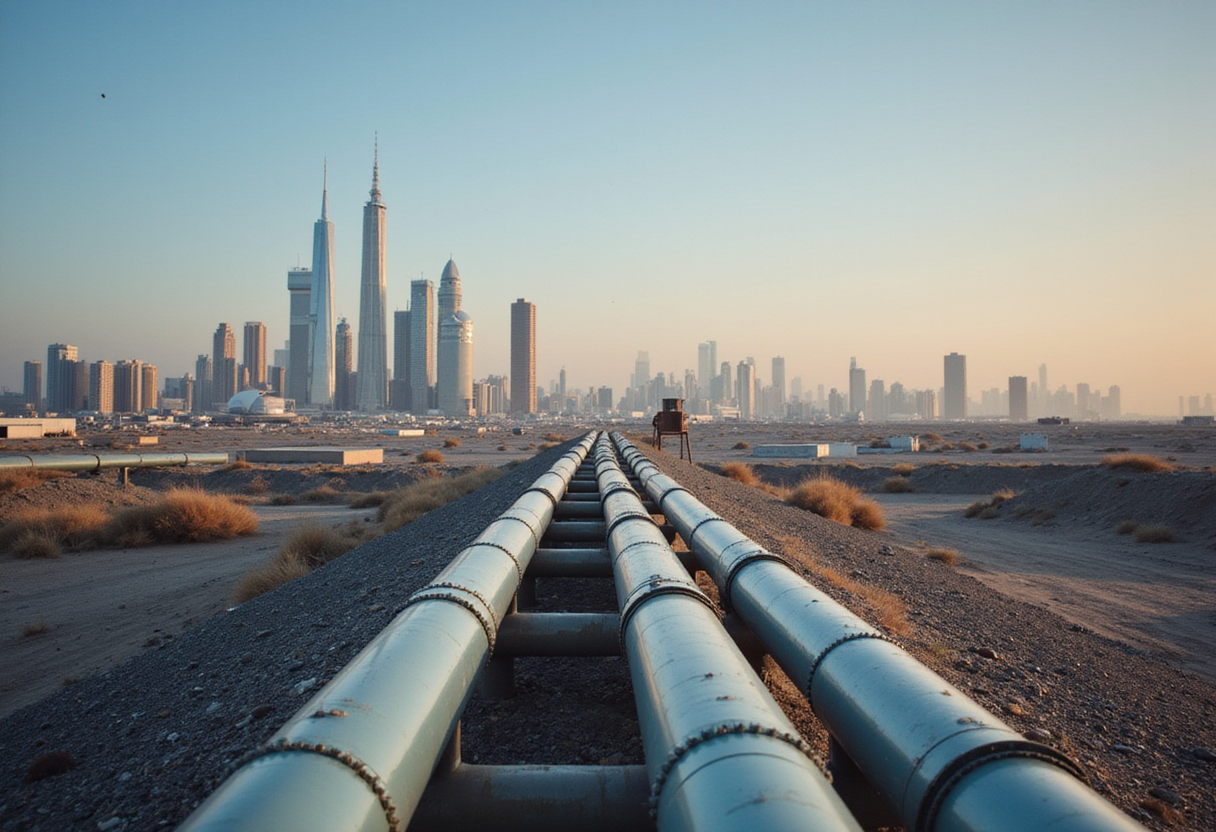
The Saudi East-West crude pipeline, better known as Petroline, has returned to normal service after a reported strike on the line. Briefs Finance carried the headline without specifying a date, damage figure, or named perpetrator for the incident.
Built in the early 1980s, the 1,200-kilometre line carries Arabian Light and other grades from gathering and stabilization plants in the Eastern Province to the Yanbu export terminal on the Red Sea. Operator Saudi Aramco has not issued a disruption estimate.
How much crude does Petroline move?
Designed capacity sits near 5 million bpd. In normal operation, throughput typically runs 2.5–3.5 mmbpd depending on east-west demand split. The bidirectional configuration gives Riyadh a route to bypass the Strait of Hormuz when needed for European, Mediterranean, and selected Asian buyers.
Of the crude moving west, a portion feeds the Yanbu domestic refinery and the Saudi Aramco Base Oil Company lube plant. The balance loads for export through the Yanbu Marine Terminal, where four crude berths serve VLCCs and smaller carriers.
Why does the Yanbu corridor matter?
- Yanbu is the closest Saudi loading point to European and Mediterranean refineries.
- The line offers redundancy if Hormuz transit is threatened or congested.
- Suezmax and Aframax tankers can load at Yanbu and clear via Bab el-Mandeb without passing Hormuz.
- Yanbu also feeds a major domestic refining and petrochemical cluster at Yanbu Industrial City.
Historical strike context
Yemen's Houthi movement has claimed multiple attacks on Saudi energy infrastructure since 2019:
- September 2019: Abqaiq processing plant and Khurais field — roughly 5.7 mmbpd offline for about two weeks.
- 2021: claimed strikes on individual Petroline segments near Riyadh corridor stations.
- 2022: drone and missile attacks on storage tanks and loading facilities at Yanbu and Jeddah.
- Post-2019 events have produced operational disruptions but none approaching the September 2019 production loss.
Aramco's protective posture
Since the 2019 attacks, Aramco has layered defenses along its right-of-way and processing sites. Published measures include buried fiber-optic sensing, aerial drone patrols, and rapid-response teams based at interval stations on the pipeline. Aramco has also moved parts of its storage capacity underground at vulnerable points.
What is confirmed about this incident?
Very little. The Briefs Finance headline does not specify:
- A date or time of the reported strike.
- The segment number or location along the 1,200 km route.
- The mechanism — drone, missile, or ground action.
- A party claiming responsibility.
Aramco's official news channel and the Saudi Ministry of Energy had not posted confirmation or denial at the time the headline circulated. Al-Masirah, the Houthi-aligned outlet, had not posted a claim.
Market reaction
Brent and WTI futures showed no measurable move tied to the headline at the time of publication. Recent attacks on Saudi assets have typically produced $1–$3/bbl price spikes that reverse within hours as Aramco confirms continuity.
The muted response reflects either a low-impact event near one of the line's less-critical stations, or a market that has priced in the recurring strike pattern across Gulf infrastructure since 2019.
Tanker tracking at the Yanbu Marine Terminal will give the cleanest near-term read. AIS feeds showed continued vessel movements in and out of the port through the relevant period.
Watch item
The next data points to monitor: an Aramco or Saudi energy ministry statement quantifying any operational disruption, tanker queue and throughput changes at Yanbu, and the next Joint Organisations Data Initiative (JODI) export release, which will indicate whether Yanbu loadings moved in the affected window.
via Google News: Pipelines and midstream (Source)
More from James Calloway
Show full bio
Staff writer covering industry trends and analytics at Rig & Refinery.
384 articles
Adjoining reports
- Saudi East-West crude pipeline flows as normal, traders say
- Saudi East-West oil pipeline operating normally: report
- Saudi Arabia Resumes Yanbu Crude Loadings After Pipeline Restart
- Saudi East-West Pipeline Flows at Normal Rates, Bloomberg Reports
- Saudi East-West pipeline delivers 5.8 million barrels: minister