Well report No. RR-7549 · T7N · R38W · SEC 7 · filed October 13, 2026
Midstream & PipelinesWell report
Saudi Pipeline Said to Have Restarted, Easing Oil Prices
Seoul Economic Daily says Saudi Arabia's East-West Pipeline has restarted, easing oil prices. The item names no throughput, no restart date, and quotes no executive — a single-source flag traders should verify before pricing it in.
Field notes
- The East-West Pipeline (Petroline) has installed capacity of about 5 million bpd and runs roughly 1,200 km from Abqaiq to Yanbu.
- The restart claim comes from a single Seoul Economic Daily item syndicated via Google News; no restart date is given.
- No Saudi Aramco executive or Ministry of Energy official is quoted in the source.
- Petroline lets Saudi Arabia export crude to Red Sea VLCCs without any tanker transiting the Strait of Hormuz.
- The source does not name a benchmark, throughput figure, or price level that would let traders quantify the 'easing' claim.
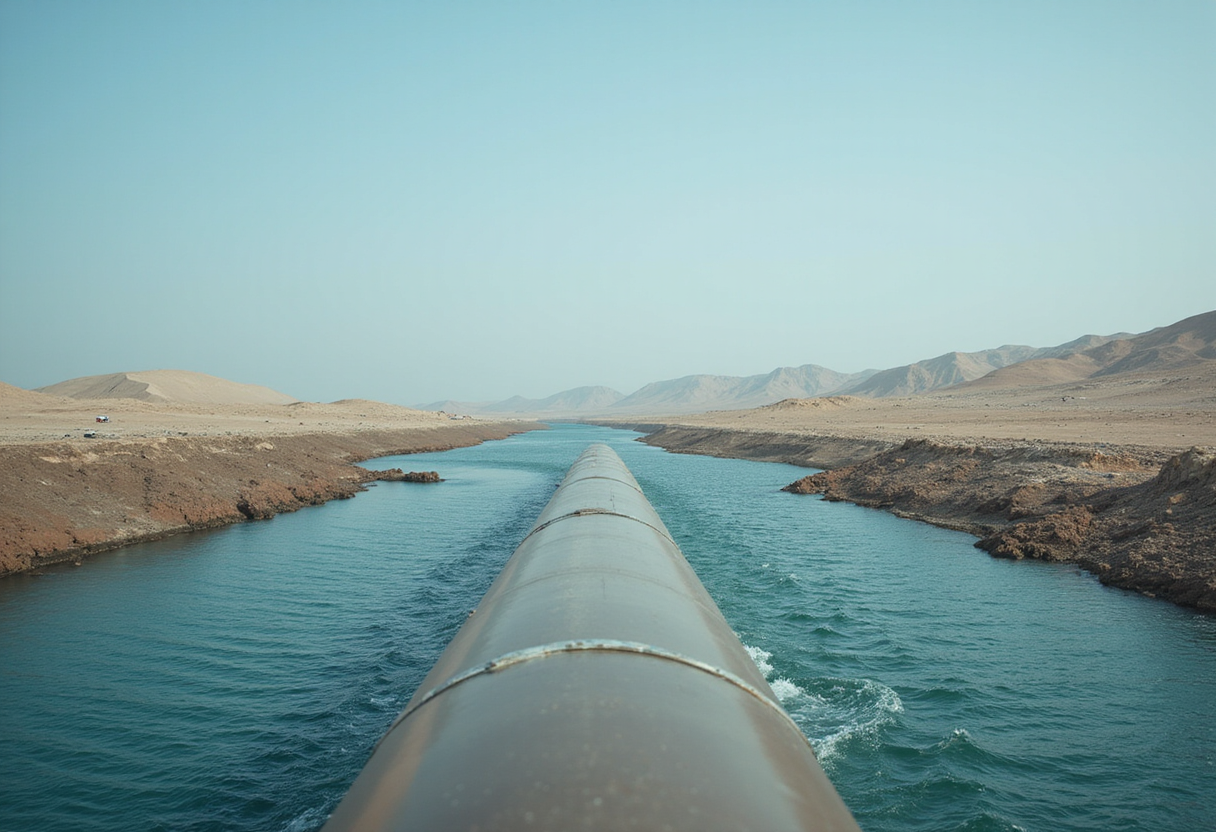
Five million barrels a day, if the line is open
Saudi Arabia's East-West Pipeline — a 1,200-kilometre crude artery that sidesteps the Strait of Hormuz — carries about 5 million barrels per day (bpd) at full nameplate capacity (the line's designed maximum throughput). The Seoul Economic Daily reports the system has restarted and that oil prices have eased as a result. The headline moves. The detail does not.
The takeaway: capacity is real, the restart claim is single-sourced, and traders have to decide which side of that ledger matters today.
What is the pipeline?
The story points to the East-West Pipeline, branded Petroline by Saudi Aramco (the state oil major). The line runs from Abqaiq, in the Eastern Province, west across the kingdom to the Red Sea export terminal at Yanbu. Installed throughput sits near 5 million bpd. Yanbu also hosts a NGL (natural gas liquids) fractionation plant and a SAMREF (Saudi Aramco–Mobil joint-venture) refinery of 400,000 bpd, so a Petroline restart touches export logistics well beyond crude alone.
Geopolitically, Petroline is Saudi Arabia's pressure-relief valve. When the Strait of Hormuz faces risk — Iranian seizures, Houthi attacks on Red Sea shipping, tanker-insurance hikes — crude can still reach VLCCs (Very Large Crude Carriers, the largest tanker class) at Yanbu without a single barrel transiting the strait. Full 5-million-bpd availability would meaningfully change Persian Gulf supply optionality. A nominal flow at, say, 300,000 bpd would shift almost nothing in benchmarks.
The takeaway: the identity of the line is clear, but the source supplies no number that lets a trader tell the two scenarios apart.
What does the source actually say?
The Seoul Economic Daily item, surfaced through a Google News RSS feed (a machine-readable syndication stream), arrives as a headline and a hyperlink. No executive is quoted. No Ministry of Energy readout is cited. No benchmark — Brent (the global seaborne benchmark), Dubai (the Middle East marker), or WTI (West Texas Intermediate, the U.S. benchmark) — is named with a level or a move.
Three operational data points would settle the story. First, a restart date. Second, a throughput figure in barrels per day. Third, an attestation from Saudi Aramco or the Ministry of Energy in Riyadh. The Seoul Economic Daily item offers none of the three. The load-bearing claim — "easing oil prices" — therefore rests on an unanchored assertion carried by a single regional daily in a translated headline. Priya Raman will flag it as a single-source trade-press item until better lands.
The takeaway: a headline that names no number, dates no event, and quotes no principal is a flag, not a story.
Why traders still care
The reason this thin report still merits desk attention: Yanbu is a real choke point. A genuine restart would free Middle East barrels to load onto VLCCs at Yanbu, easing tonnage demand in the Persian Gulf and adjusting freight rates on both coasts of the Arabian Peninsula. Insurers track the line closely. So do the desks that price the Dubai–Brent differential (the gap between the Middle East marker and the global benchmark), since Red Sea loadings can pull barrels away from the Gulf pricing window.
OPEC+ (the Organization of the Petroleum Exporting Countries and allied producers) communication policy has also made single-shipment flow data politically sensitive this year. Aramco has, at times, paused loadings to support the producer group's price band. A Petroline restart could mask that, or could legitimately add barrels. The two read entirely differently into the front-month (nearest-expiry futures) tape.
The takeaway: even an unverified restart shifts how tanker tonnage and differentials trade, which is why scepticism here has real cost.
The caveat
Treat the report as a flag. Treat it as a story only after Saudi Aramco's corporate-relations desk posts a loadings bulletin, or after the Saudi Press Agency wires a Ministry of Energy line. Trade-press readers in Houston, Aberdeen, and Singapore have seen this exact framing recycled before in 2024 and again in early 2025 — sometimes tied to Houthi damage, sometimes tied to routine maintenance, often conflated in wire summaries. The pattern argues for patience, not panic.
The skepticism is plain. A single Aramco statement would silence the doubt. Without one, the doubt stays.
Watch items
- Aramco Trading loadings bulletin, or any Aramco corporate notice on Yanbu throughput
- Brent and Dubai front-month moves through Asian trading hours
- Saudi Press Agency wires from the Ministry of Energy in Riyadh
- OPEC+ communications around any producer-group meeting on supply
The next dispatch from Saudi Aramco's investor-relations desk will tell readers whether the East-West Pipeline is moving oil — or whether Seoul Economic Daily moved first and the oil followed.
via Google News: Pipelines and midstream (Source)
More from Priya Raman
Show full bio
Senior reporter covering technology and product news in Oil and gas industry operations and markets at Rig & Refinery.
464 articles
Adjoining reports
- Saudi East-West Pipeline Now Pumping 5.8M bpd, Minister Reports
- Saudi East-West Pipeline Restored to 5.8 Million bpd
- Saudi East-West Pipeline Back at Roughly 3.5 Million BPD After Repairs
- US energy chief: Saudi oil pipeline back online within days
- Saudi East-West Pipeline Back Online at 40% of Pre-Attack Capacity