Well report No. RR-9211 · T1N · R43W · SEC 25 · filed October 10, 2026
Petroleum MarketsWell report
Attacks Cut Saudi Oil Output and East-West Pipeline Flow
State news agency reports attacks have cut Saudi oil output and East-West pipeline flow; traders await volumetric assessment and restoration timeline from Aramco.
Field notes
- Attacks have cut Saudi oil production, according to state news agency SPA
- East-West pipeline flow reduced; line links Eastern Province fields to Red Sea export terminals
- Pipeline has roughly 5 million bpd capacity and serves as the Hormuz bypass route
- No immediate volumetric figure for lost output published in initial bulletin
- Follow-up Aramco statement on lost barrels and repair timeline is the key watch item
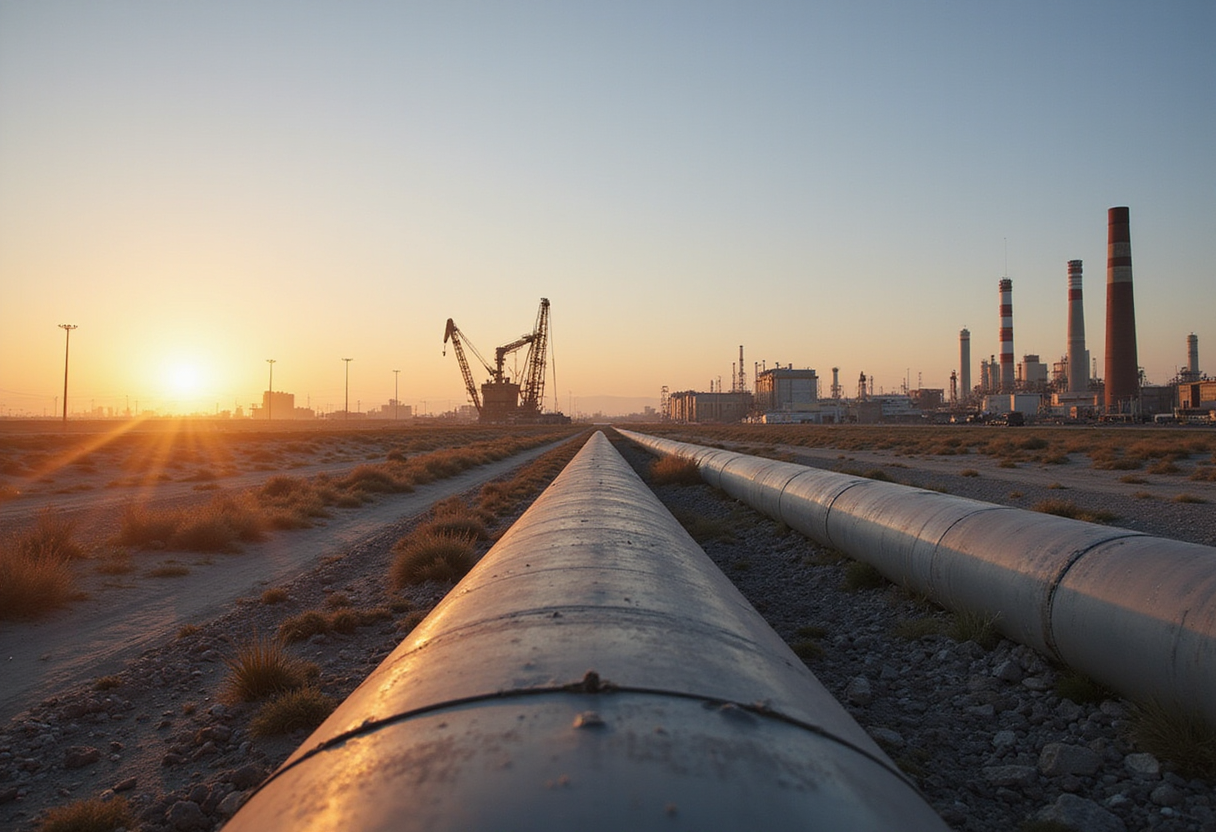
Drone and other attacks have cut Saudi oil output and reduced flow on the East-West pipeline, the kingdom's state news agency reported, marking the latest disruption to infrastructure that carries Saudi crude from Eastern Province fields to Red Sea export terminals.
The report from the official Saudi Press Agency confirms two operational impacts: a reduction in oil production and a curtailment of throughput on the East-West pipeline, the 5 million bpd-capacity conduit that links producing areas around Abqaiq and Ghawar with Yanbu on the Red Sea. The agency did not immediately publish a full quantification of the lost barrels in its initial bulletin, and market participants will look to Aramco and the energy ministry for a volumetric assessment.
What infrastructure is affected?
The East-West pipeline, operated by Saudi Aramco, remains the kingdom's principal overland alternative to the Strait of Hormuz. Any constraint on the line complicates Aramco's strategy of routing crude westward to Red Sea loading points, a routing option the company has promoted precisely because it bypasses the Gulf chokepoint.
Reduced flow on the line, combined with the reported production cut, means the disruption touches both the upstream and midstream links of the Saudi supply chain. The state news agency attribution matters here: Saudi authorities have historically used SPA to control the flow of operational detail after attacks on energy assets, releasing damage assessments in stages.
How does this fit the pattern of recent attacks?
The incident continues a series of strikes on Saudi energy infrastructure that has punctuated the past several years of regional tension. Previous attacks have targeted:
- The Abqaiq processing complex and Khurais field in September 2019, which temporarily removed roughly 5.7 million bpd of capacity
- East-West pipeline pumping stations, struck by drones in May 2019
- Red Sea and Gulf coastal facilities in subsequent incidents
Each event tested the kingdom's ability to restore throughput quickly and to maintain export commitments to Asian and European customers drawn from its official selling price allocations.
What is the market watching now?
The immediate questions are volumetric and logistical. Traders will want the size of the output reduction in barrels per day, the expected restoration timeline, and whether Aramco will draw on storage at Yanbu or within the kingdom to keep cargoes loading on schedule.
A second question concerns freight and insurance. Attacks on Saudi infrastructure typically push war-risk premiums higher for tankers calling at Gulf and Red Sea terminals, and any sustained disruption would feed through into crude differentials for Middle East grades.
A third is the spare-capacity calculus. Saudi Arabia holds the world's largest reserve of idle production capacity, and that buffer exists to absorb exactly this kind of event. Analysts will frame the severity of the incident against how much of that cushion the reported cuts consume — price commentary in the coming sessions will turn on that arithmetic, and it belongs to the analysts, not the wire copy.
The watch item is the follow-up statement from Aramco or the energy ministry quantifying lost output and giving a repair schedule, together with any change in the kingdom's nominations to customers for the coming month.
via Google News: Pipelines and midstream (Source)
More from Daniel Okafor
Show full bio
Market editor covering consumer brands and retail at Rig & Refinery.
321 articles
Adjoining reports
- Saudi Arabia Halts East-West Crude Pipeline After Drone Strikes
- East-West Pipeline Flows Uninterrupted, Source Tells Reuters
- Riyadh Halts Key Oil Pipeline After Drone Attacks Blamed on Iraq-Based Drones
- Satellite Imagery Shows Partial Repair of Saudi East-West Pipeline
- Saudi Arabia Halts Key Crude Pipeline After Drone Strike Launched From Iraq