Well report No. RR-3263 · T13N · R35W · SEC 13 · filed October 9, 2026
Midstream & PipelinesWell report
Canada weighs a new West Coast oil pipeline — here's where it stands
No regulator filing, no proponent, no FID: Canada's much-discussed second West Coast oil pipeline remains talk, with TMX still the only Pacific outlet.
Field notes
- Canada has no sanctioned or applied-for new West Coast oil pipeline beyond Trans Mountain
- Trans Mountain expansion, completed in 2024, remains the sole Pacific export route
- No CER application, proponent, or FID exists for any successor line
- The National Post's assessment: Canada is not close to a new West Coast pipeline
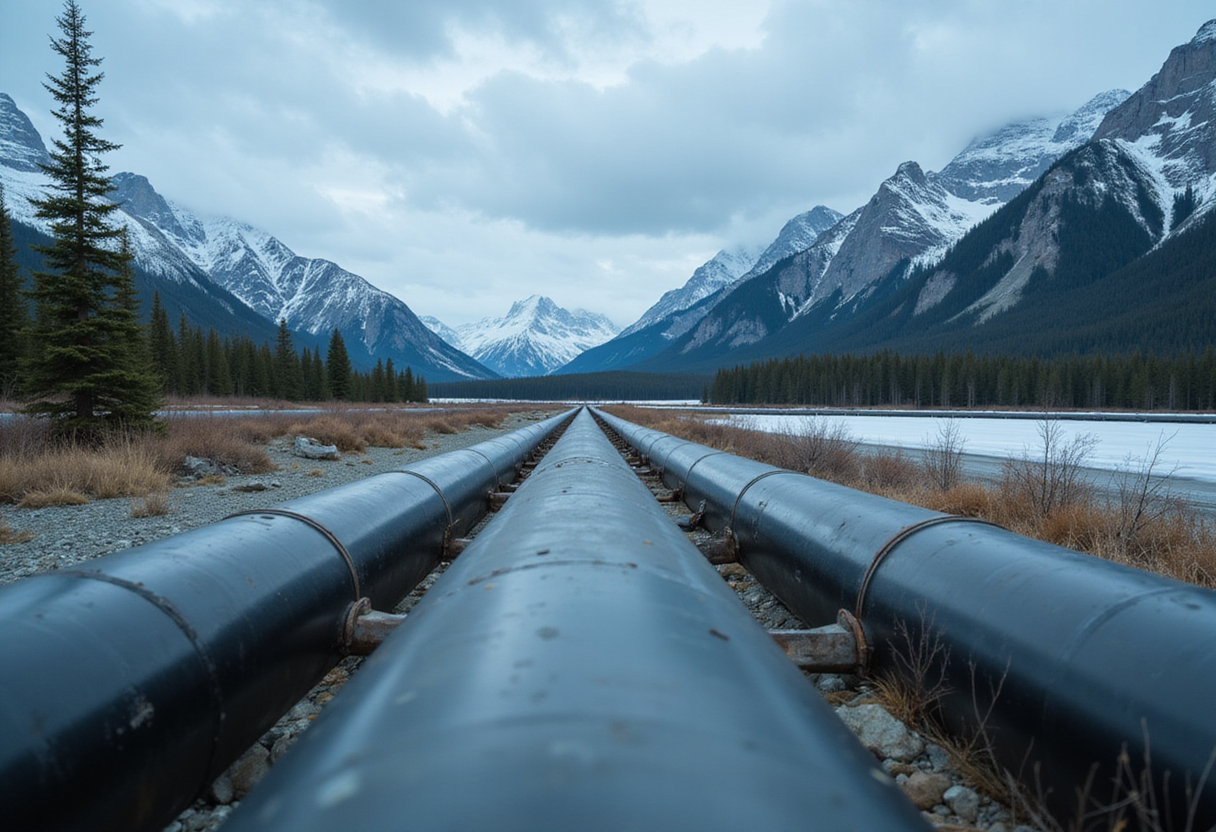
No application, no proponent consortium, and no sanctioned barrel-moving capacity: that is the state of Canada's push for a new West Coast oil pipeline as of the latest assessment by the National Post.
The question itself — how close is Canada to a new West Coast oil pipeline? — is the operative one, and the honest answer is: not close. The Trans Mountain expansion, completed in 2024 at 890,000 bpd of added capacity, remains the only conduit from the Alberta oil sands to the Pacific coast. Any successor line exists, at this stage, only as discussion.
Why does the question keep coming back?
Western Canadian producers have chased tidewater access for more than a decade because inland pricing — WCS at Hardisty versus waterborne benchmarks — discounts Alberta barrels. Trans Mountain solved part of that arithmetic. Enthusiasm for a second line reflects the view, held by parts of the industry and some provincial officials, that Asia-facing demand growth justifies more export capacity than a single corridor can provide.
Against that stand the constraints that killed earlier proposals: Indigenous consultation requirements, federal and provincial permitting, coastal tanker opposition in British Columbia, and the capital risk that sank Energy East and Northern Gateway before ground was broken.
What separates this from a sanctioned project?
Everything a trade reader looks for is absent:
- No regulatory filing with the Canada Energy Regulator
- No named proponent with an open-season volume commitment
- No capital cost estimate or FID timeline
- No routed right-of-way agreement
Until those boxes are ticked, any West Coast pipeline talk sits firmly in the appraisal-stage speculation column, not on the sanctioned-projects ledger.
What is the watch item?
Watch for three signals that would move this from talk to project: a formal CER application, a commercial open season with producer volume subscriptions, and First Nations equity partnership structures of the kind that ultimately carried Trans Mountain through its final approvals. Absent those, the story remains a policy debate — one the National Post frames with a simple verdict: Canada is not yet close.
For refiners and crude marketers on the Pacific rim, the practical takeaway is unchanged: West Coast export capacity today means TMX, full stop. Any incremental barrel beyond 890,000 bpd is years and one very large FID away.
via Google News: Pipelines and midstream (Source)
More from James Calloway
Show full bio
Staff writer covering industry trends and analytics at Rig & Refinery.
177 articles
Adjoining reports
- Ottawa Fast-Tracks Pacific Oil Pipeline as Alberta Separation Vote Nears
- Canada Moves to Fast-Track New West Coast Oil Pipeline
- Carney Says Producers Back New West Coast Oil Pipeline
- Ottawa to Fast-Track Crude Pipeline Aimed at Non-US Markets
- CAPP Backs National Interest Designation for West Coast Oil Pipeline