Well report No. RR-1962 · T22N · R30W · SEC 10 · filed October 10, 2026
Midstream & PipelinesWell report
Saudi East-West Pipeline Back at 5.8 Million bpd Throughput
Flows on Saudi Arabia's East-West Petroline have returned to 5.8 million b/d, restoring full Hormuz-bypass capacity between Abqaiq and the Red Sea terminal at Yanbu.
Field notes
- East-West pipeline flows restored to 5.8 million bpd
- The line links Eastern Province crude with the Red Sea export terminal at Yanbu
- Full Petroline throughput restores Saudi Arabia's Hormuz-bypass export capacity
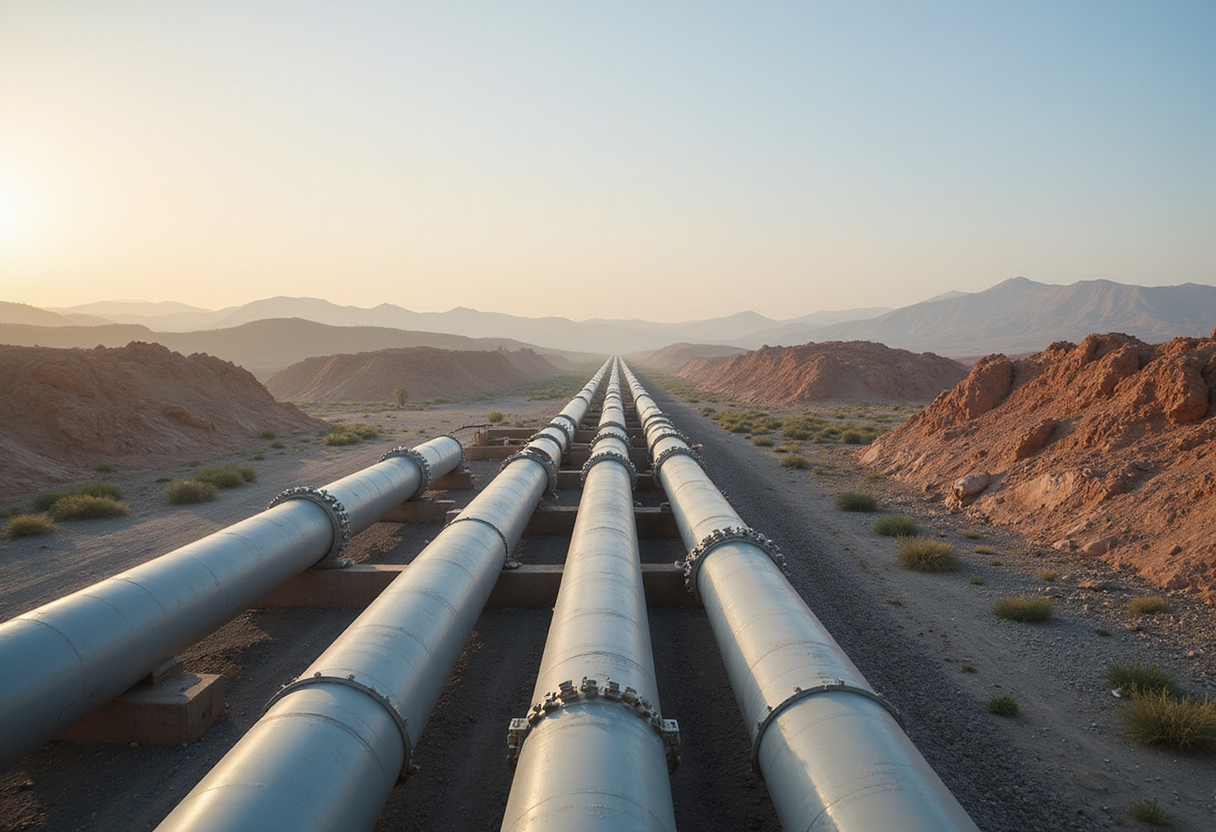
Flows on Saudi Arabia's East-West crude pipeline, the Petroline, have returned to 5.8 million b/d, according to a report carried by Azernews. The restoration puts throughput back at the line's nominal design capacity and reconnects the Kingdom's Eastern Province producing heartland with Red Sea export infrastructure at Yanbu.
The 1.2-million-metre-class conduit runs roughly 1,200 km from Abqaiq to the Yanbu terminal on the Red Sea, giving Saudi Aramco a route to European and Atlantic-basin buyers that bypasses the Strait of Hormuz entirely. At 5.8 million b/d, the line can carry about half of the Kingdom's crude production, making it the single most consequential piece of spare logistics in the global market.
Why the number matters
The 5.8-million-b/d figure is the pipeline's nameplate capacity. When Petroline runs full, Saudi Arabia can load crude from the Red Sea regardless of conditions in the Gulf, and exporters tracking Arab Light and Arab Medium availabilities watch Yanbu berth schedules as a proxy for how much Barri-era and Khurais-era volumes are moving west.
A restoration to full throughput also signals that whatever constraint had reduced flows — the Azernews report did not specify the cause, the duration of the reduction, or the startup date of the restoration — has cleared. Market participants will treat that as an availability signal for spot cargoes loading outside Hormuz.
What the East-West line does
The system serves three functions for Riyadh:
- Moves Eastern Province crude to Yanbu for export into the Red Sea and Suez corridor
- Provides Hormuz-bypass capacity that can be surged when Gulf shipping is at risk
- Feeds domestic refineries on the western side of the Kingdom, including the Jeddah and Yanbu complexes
The bypass role is the one analysts price. Any event that threatens tanker traffic in the Strait of Hormuz — through which roughly a fifth of globally traded oil passes — puts a premium on Petroline throughput data, and the 5.8-million-b/d reading confirms the full buffer is back in service.
Watch item
The open question is duration and utilisation. Nameplate restoration does not guarantee sustained full-line operation, and Saudi crude allocation decisions — set against OPEC+ production policy — determine how much of the 5.8 million b/d the Kingdom actually elects to pump westward. Traders will watch Yanbu loading programmes over the coming weeks for confirmation that the restored capacity translates into incremental Red Sea barrels.
via Google News: Pipelines and midstream (Source)
More from Elena Vasquez
Adjoining reports
- Saudi East-West Line Carries Near 6 Million Bpd, Bloomberg Says
- Saudi East-West Pipeline Restored to 5.8 Million bpd
- Saudi East-West Pipeline Running at 50% as Crude Exports Resume
- Saudi Arabia's East-West Pipeline Resumes Crude Exports: Report
- Saudi Arabia Restores East-West Pipeline Capacity to 5.8 Million bpd