Well report No. RR-5292 · T18N · R21W · SEC 18 · filed October 9, 2026
Midstream & PipelinesWell report
WA Governor 'Disappointed' as Canada Fast-Tracks B.C. Oil Pipeline
Washington's governor is 'disappointed' over Canada's fast-track of a new oil pipeline to British Columbia, per News From The States. The report did not name the proponent, capacity, route, or in-service date.
Field notes
- Canada has fast-tracked a new oil pipeline to British Columbia, per News From The States.
- Washington's governor characterized the move as 'disappointed' — the only direct quotation in the source report.
- The source report did not name the proponent, capacity, route, or targeted in-service date.
- Trans Mountain Expansion, the most recent Canadian interprovincial oil pipeline, entered service in May 2024 at a nameplate of 590,000 bpd.
- Northern Gateway, the previous B.C. coast proposal, received federal approval in 2014 and was abandoned in 2017.
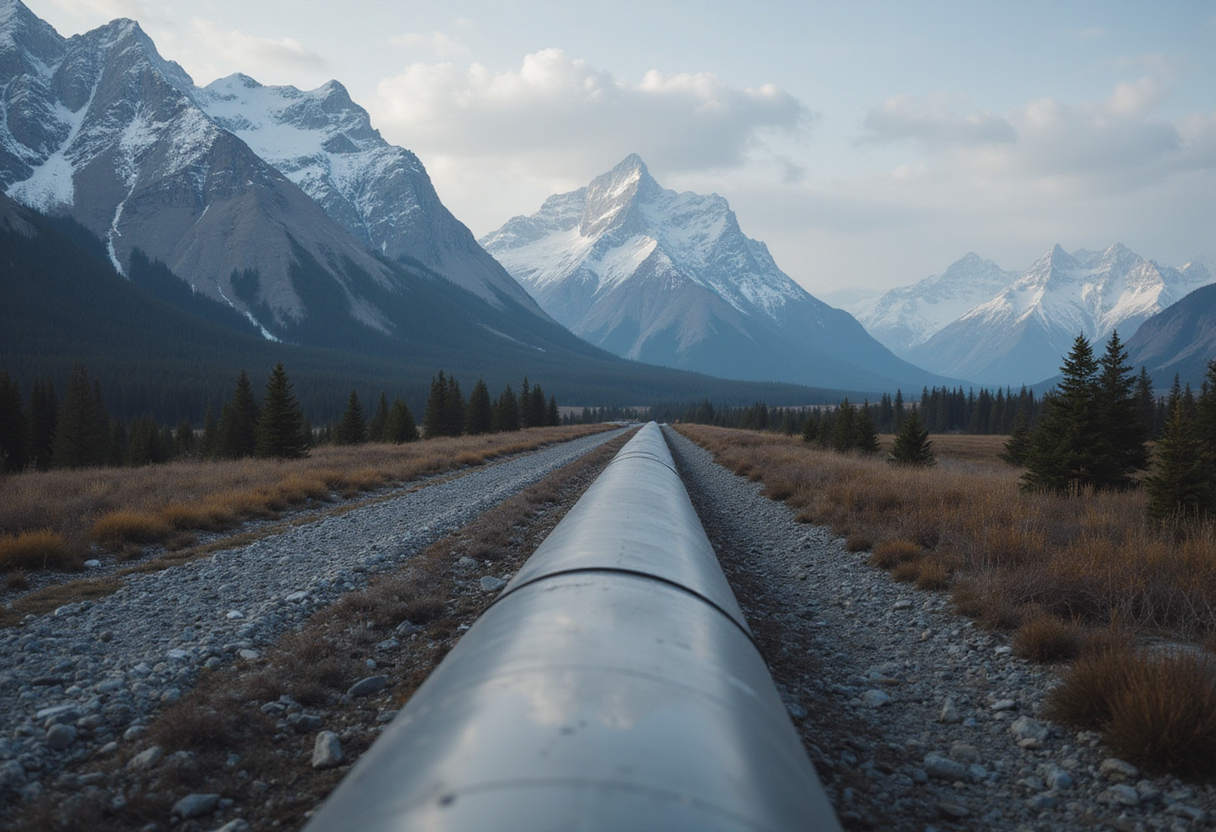
A new oil pipeline to British Columbia has been placed on a fast-track regulatory path by the Canadian government, drawing a "disappointed" response from Washington's governor in a report carried by News From The States.
The headline-level disclosure, circulated without accompanying capacity, route, sponsor or timeline data, frames a familiar cross-border dispute between Olympia and Ottawa over interprovincial oil infrastructure serving Pacific-basin shippers.
What the fast-track designation covers
Canadian fast-track authorizations, issued by federal cabinet or relevant ministers, typically substitute a streamlined provincial-federal review for the standard Impact Assessment Act process. For a long-haul oil pipeline, the practical effect is to compress the timeline between project announcement and construction decision, while shifting much of the remaining review to provincial permits and Indigenous consultation.
The mechanism has been used previously on the Trans Mountain Expansion, which the federal government acquired and brought into service in May 2024 at a nameplate of 590,000 bpd, and on several LNG export proposals in northern B.C. Trans Mountain provides the closest operating analogue to the current announcement and the most recent benchmark for tanker traffic through the Strait of Georgia and the Strait of Juan de Fuca.
What the governor actually said
Washington's governor was quoted in the source report only in the single adjective "disappointed," with no surrounding sentence. The word nonetheless signals a posture consistent with prior administrations in Olympia, which have opposed or expressed reservations about crude-by-rail terminals and tanker routes that would carry additional Alberta-sourced volumes into Salish Sea waters.
The state lacks a direct regulatory veto over a Canadian interprovincial pipeline, but it can shape the marine side of any project through ballast water rules, pilotage coordination, and joint U.S.-Canada spill-response protocols on shared waters.
What the source did not specify
The report carried by News From The States did not include the operational parameters an upstream desk would require before assigning a project to the construction-watch list:
- The name of the proponent company or consortium
- Design capacity in barrels per day
- Receipt point in Alberta and delivery point on the B.C. coast
- Route corridor and any marine terminal siting
- Targeted in-service date
- The federal order or ministerial directive issuing the fast-track
Without those data points, the announcement remains a directional signal from Ottawa rather than a sanctioned addition to the pipeline build list.
How this fits the prior cycle
The political geometry is well established. British Columbia and Alberta have argued over interprovincial pipelines for more than a decade. Trans Mountain Expansion is in service. Northern Gateway received federal approval in 2014 and was formally abandoned in 2017 after a federal court overturned its permit. Each cycle has produced a Washington State response, and each has ended with the Canadian project moving forward on its own regulatory track.
The watch items
Three confirmations will convert the headline into a tracked project:
- A named proponent and a disclosed capacity figure in bpd
- A filed application with the Canada Energy Regulator or its successor
- A construction schedule with a right-of-way clearing date and a first-oil target
Until those land, the story is a political signal from both sides of the border, not a pipeline addition.
via Google News: Pipelines and midstream (Source)
More from Elena Vasquez
Adjoining reports
- Ottawa to Fast-Track Crude Pipeline Aimed at Non-US Markets
- Canada to Fast-Track Oil Pipeline Aimed at Reducing US Export Dependence
- Ottawa Fast-Tracks Pacific Oil Pipeline to Cut US Reliance
- Ottawa Moves to Fast-Track Pacific Oil Pipeline Project
- Canada Moves to Fast-Track Oil Pipeline Aimed at US Diversification