Well report No. RR-5950 · T6N · R22W · SEC 6 · filed October 2, 2026
Midstream & PipelinesWell report
Alberta-to-B.C. Coast Oil Pipeline Revives National-Interest Debate
A new proposal for an oil pipeline from Alberta to B.C.'s south coast raises the question of a national-interest designation — the same corridor that produced the $34-billion Trans Mountain expansion.
Field notes
- Castanet published a discussion piece asking whether a proposed Alberta-to-B.C.-south-coast oil pipeline should be designated a project of national interest.
- The prior project on the corridor, the 890,000-bpd Trans Mountain expansion, cost roughly $34 billion after the federal government bought the system for $4.5 billion in 2018.
- No proponent, route, capacity figure, or timeline is identified for the proposed new line, placing it at the policy-debate stage rather than a sanctioned project.
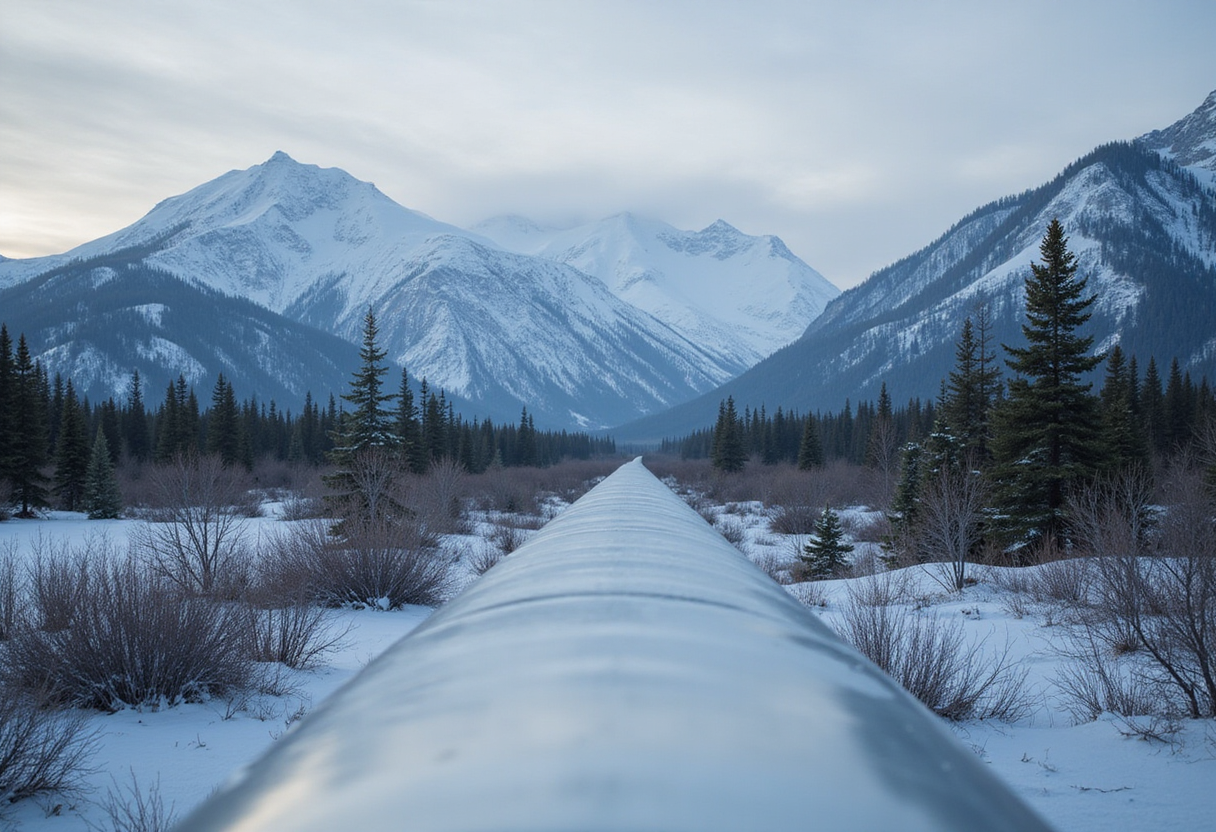
The question of whether a proposed oil pipeline from Alberta to British Columbia's south coast should carry a formal designation as a project of national interest has returned to the center of Canadian energy policy debate, according to a discussion piece published by Castanet.
The designation question matters to operators and midstream watchers for one reason: a pipeline from the Alberta oil sands to tidewater on the B.C. coast would add Pacific-basin export capacity for Canadian heavy crude, a stream that still leans heavily on the U.S. Midwest and Gulf Coast markets. The Trans Mountain expansion, brought into service in 2024 at 890,000 bpd, was the last major effort to break that dependence, and it reached the coast only after years of permitting delays, court challenges, and a federal purchase of the original asset.
Castanet's piece frames the new proposal around the political mechanism rather than the barrel count. It asks whether Ottawa should invoke a national-interest designation — a tool that could, depending on its legal form, streamline federal review and limit the ability of provincial or municipal authorities to block construction. The article presents the question as an open one for readers rather than an endorsement of either answer.
The backdrop is familiar to anyone who tracked the Trans Mountain file. British Columbia's Lower Mainland remains the only practical corridor between Alberta's producing basins — the Athabasca, Peace River, and Cold Lake heavy-oil regions — and deepwater tanker access to Asian refiners. It is also a corridor with entrenched opposition from some First Nations, municipal governments, and environmental groups, and it crosses terrain where construction costs for the Trans Mountain expansion ran to roughly $34 billion against an early estimate near $7.4 billion.
Supporters of a national-interest designation argue that Canada's export infrastructure still constrains crude pricing. Western Canada Select traded at wide discounts to West Texas Intermediate for years before egress relief arrived, and pipeline apportionment episodes in 2018 forced producers in the Alberta bitumen belt to curtail volumes under provincial production curtailment rules. Any new line to the south coast would add incremental egress and, in the view of proponents, strengthen the price realizations that oil-sands operators report each quarter.
Opponents counter that a designation would not erase the risks that sank earlier private-sector attempts. Kinder Morgan walked away from Trans Mountain in 2018 before the federal government bought the system for $4.5 billion. Legal challenges tied to Indigenous consultation and marine shipping occupied years of the project schedule. A designation on paper does not change court dockets, and Castanet's framing leaves open whether the tool would survive the same tests.
The piece does not identify a specific proponent, a route, a capacity figure in barrels per day, or a startup timeline for the proposed line, and no federal decision on a designation appears imminent. That places the project firmly in the speculative column for now — a policy conversation, not a sanctioned capital project with an FID behind it.
What to watch: whether Ottawa signals any willingness to test a national-interest mechanism for new crude egress, whether Alberta advances concrete route or capacity studies, and whether any prospective operator steps forward with a commercial open season. Until one does, the proposal remains a question mark attached to the same corridor that took more than a decade and a federal bailout to develop once.
via Google News: Pipelines and midstream (Source)
More from James Calloway
Show full bio
Staff writer covering industry trends and analytics at Rig & Refinery.
135 articles
Adjoining reports
- CAPP Backs National Interest Designation for West Coast Oil Pipeline
- Canada Fast-Tracks 1 Million-Bpd Alberta-to-Pacific Oil Pipeline
- Canada Names West Coast Pipeline First 'National Interest' Project
- Ottawa to Fast-Track Crude Pipeline Aimed at Non-US Markets
- Delta Oil Pipeline Could Win 'Project of National Interest' Status