Well report No. RR-2049 · T7N · R2W · SEC 19 · filed November 11, 2026
Energy Transition in OilWell report
NRC clears four-reactor Long Mott plant at Dow's Texas site
The NRC approved construction of four Xe-100 reactors at Dow's Long Mott Generating Station in Texas, with earliest completion set for July 1, 2033 and no operating license yet.
Field notes
- Four Xe-100 reactors cleared for construction at the Long Mott Generating Station on Dow's UCC Seadrift Operations site in Texas, each rated up to 80 MW electric and 200 MW thermal.
- NRC review took less than 18 months, a record pace for contested hearings.
- Permit sets July 1, 2033 as the earliest date for completion; the operating license remains to come.
- Long Mott would be the first U.S. industrial site powered and heated directly by nuclear fission; it is the first HTGR construction approval in nearly 60 years.
- X-energy's Tennessee HALEU fuel fabrication plant is on track to open in early 2028; Dow's final decision is not expected before 2028.
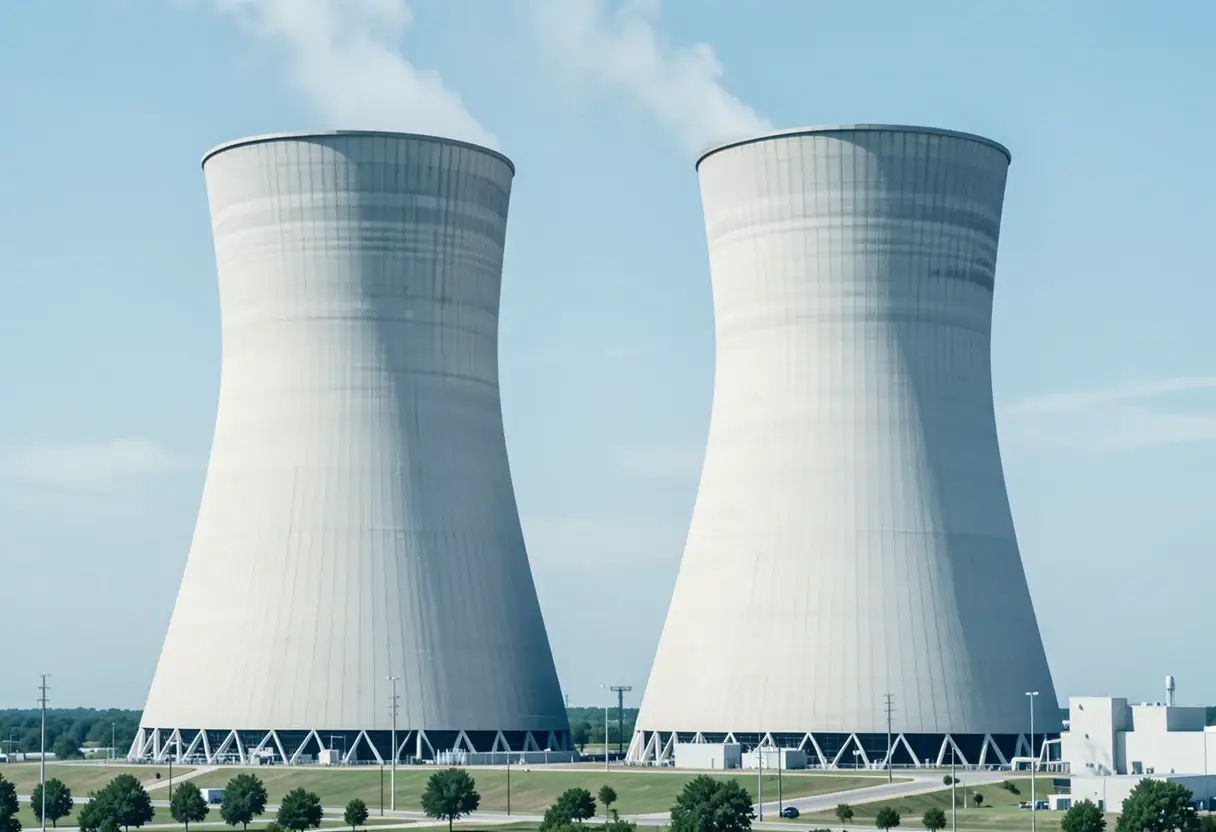
Four Xe-100 reactors, each designed to produce up to 80 megawatts of electricity and 200 megawatts of thermal output, won construction approval from the U.S. Nuclear Regulatory Commission on Monday. The joint application by X-energy and Dow Chemical covers the Long Mott Generating Station, a power and steam plant on Dow's UCC Seadrift Operations site in Texas.
The permit sets July 1, 2033, as the earliest date for completing construction. Long Mott holds no operating license, and Dow has yet to commit to the multibillion-dollar project.
What did the NRC approve?
The four units will supply electricity and high-temperature steam to Seadrift, a Dow plant that makes plastics and petroleum derivatives used in food and beverage packaging, paints and solvents. That site now relies on aging fossil-fueled equipment. With all four reactors at design output, Seadrift would be the first U.S. industrial site to draw both its power and its process heat directly from nuclear fission.
The coolant is helium, a lightweight inert gas that allows operation at temperatures well above those of conventional water-cooled reactors. In sum, the four units carry roughly 320 megawatts of electric nameplate capacity, about three percent of the 11-plus gigawatts X-energy says it hopes to build.
The NRC took less than 18 months to review the application, a record pace for contested hearings. X-energy chief executive J. Clay Sell said: "Getting the construction permit earlier than expected is reflective of the thorough and efficient work of the NRC, the reforms that have been put in place by the Congress over the last six years, and the phenomenal work of the X-energy and Dow teams."
Takeaway: The plant has its construction permit, and it still has to earn the right to run.
How did the last two gas-cooled reactors perform?
Long Mott is the first high-temperature gas reactor, or HTGR, the NRC has cleared for construction in nearly 60 years. The first, a 40-megawatt design, produced electricity at the still-operating Peach Bottom plant in Pennsylvania from 1966 to 1974. The second ran from 1979 to 1989 at Fort St. Vrain in Colorado, which today operates as a natural-gas-fired power station owned by Xcel Energy.
Both retired early because of "funding and technical problems," according to the International Atomic Energy Agency. X-energy expects its Texas reactors to run for 60 years.
Robert Taylor, X-energy's vice president of regulatory affairs and licensing, told Canary Media in May that the earlier plants were "a technology ahead of their time." Fifty years on, he said, high-temperature gas reactors have operated successfully in "multiple countries," improving to the point where "it's an Edsel-to-a-Ferrari comparison," a reference to Ford's notorious automotive flop.
Takeaway: The design's operating record is short, and its advocate argues the earlier failures were financial rather than thermal.
What has to happen before Long Mott runs?
Fuel is the first constraint. X-energy holds a federal commitment for the high-assay, low-enriched uranium, or HALEU, needed to start Long Mott, plus a binding commercial agreement covering enough fuel to support at least part of its 11-plus gigawatt pipeline. That supply depends on the company's Tennessee fabrication facility, which converts HALEU into stable fuel pellets able to withstand temperatures above 1,000 degrees Fahrenheit. X-energy said in September that the plant is on track to open in early 2028.
Licensing is the second. X-energy and Dow must still ask the NRC for permission to operate Long Mott once it is built. The NRC's generic licensing schedule puts that review at roughly another 18 months, though the companies would likely file during construction.
Takeaway: Two gates remain, and both depend on things outside Dow's control.
Will Dow build it?
Dow has not made a final decision on the multibillion-dollar project and is not expected to do so before 2028, though it may consider a preliminary investment decision next year, X-energy said. Edward Stones, Dow's business vice president for energy and climate, said: "As we move forward, we will continue to evaluate the project through the lens of competitiveness, execution readiness, and capital affordability before any decision regarding construction is made."
The permit explains the wait. "The earliest date for the completion of the construction of the facility is July 1, 2033." Payoff arrives about when this year's high school freshmen gear up for their senior year of college.
Takeaway: Dow has bought the option, and the option expires in 2028.
Where the federal money sits
The approval lands in the middle of a federal push. The U.S. Department of Energy has committed tens of billions of dollars in grants, awards and loan guarantees for new reactors and for capacity expansions at existing plants. Support has held through both Trump administrations and the Biden administration, which treated carbon-free generation as a grid decarbonization tool. Quadrupling U.S. commercial nuclear capacity by 2050 is now official government policy.
The Xe-100 is one of several non-water-cooled Generation IV reactors moving through the NRC. The commission has also cleared three molten-salt-cooled units for Kairos Power in Tennessee and one liquid-sodium-cooled unit for TerraPower in Wyoming. X-energy and TerraPower are each set to receive at least $2 billion through the DOE's Advanced Reactor Demonstration Program.
Takeaway: The permits are arriving faster than the funding, and both are running ahead of the fuel.
What to watch
- Dow's preliminary investment decision, expected next year, with a full decision no earlier than 2028.
- X-energy's Tennessee fuel fabrication plant, on track to open in early 2028.
- The operating license application, roughly 18 months of NRC review once filed.
- July 1, 2033, the earliest construction completion date written into the permit.
- Delivery of at least $2 billion each to X-energy and TerraPower under the DOE's reactor demonstration program.
via canarymedia.com (Source)
More from Daniel Okafor
Show full bio
Market editor covering companies, deals and strategy in Oil and gas industry operations and markets at Rig & Refinery.
560 articles
Adjoining reports
- Nuclear-Powered FPSO Concept Design Targets Sustainable Offshore Output
- HPCL Awards Technip Energies EPC for Mumbai Refinery LMBU Units
- ENGIE and CMA CGM Plan 7,000-tpa Biomethane Plant at Le Havre
- Eddystone LNG plan targets 7.2 mtpy, 1.1 Bcf/d as FERC application lags
- Golar's Fourth FLNG Gets Heat Recovery Modules Cutting Fuel 20-25%