Well report No. RR-8444 · T2N · R16W · SEC 2 · filed October 2, 2026
Refining & PetrochemicalsWell report
Overnight drone strikes ignite fires near Lukoil's Volgograd refinery
Overnight drone strikes on Volgograd and Samara started fires near a Lukoil refinery, a chemical plant, and likely Europe's largest oil tank farm, per Euromaidan Press reporting.
Field notes
- Overnight drone strikes hit Russia's Volgograd and Samara regions, causing fires near a Lukoil refinery, a chemical plant, and likely Europe's largest oil tank farm in Samara.
- No damage assessment, outage duration, or throughput impact was reported for the Lukoil Volgograd refinery fire.
- The Samara tank farm strike, if confirmed, would be the largest oil storage facility in Europe; the operator and affected volumes remain unconfirmed.
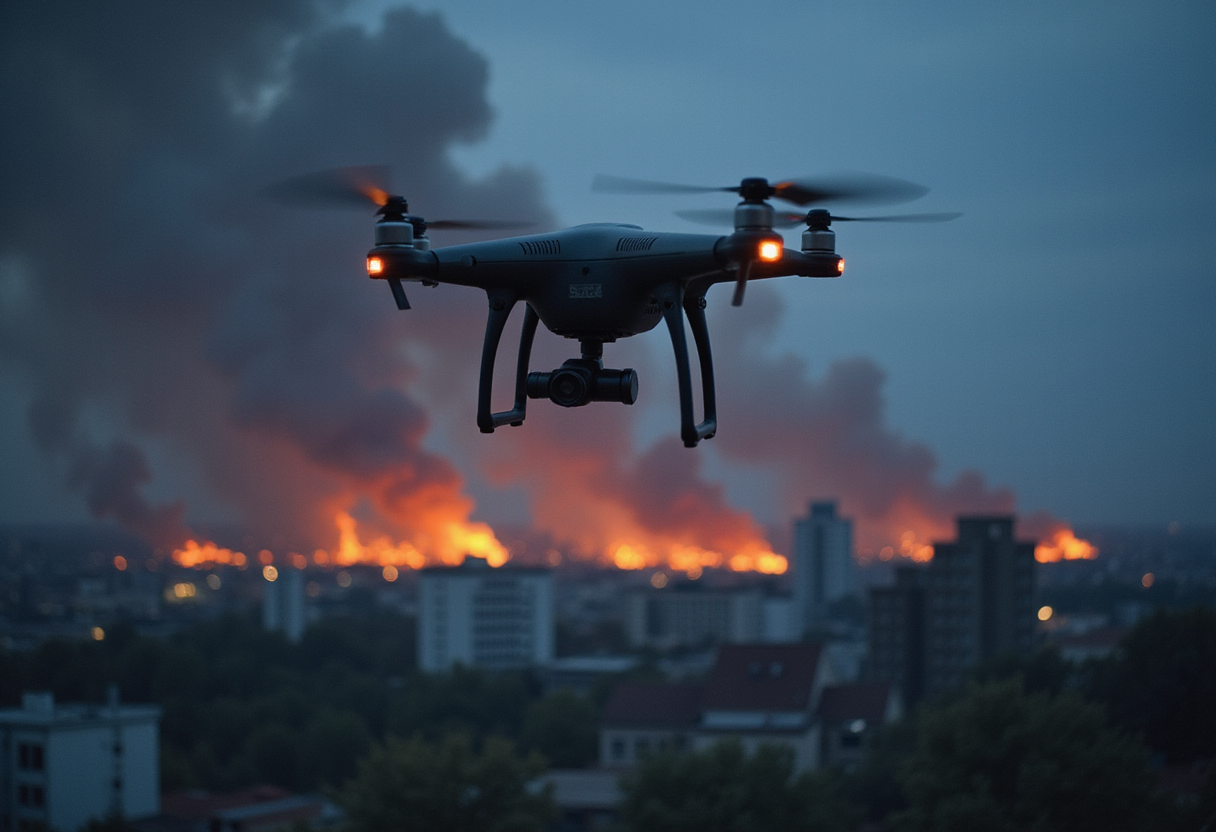
Overnight drone strikes on the Russian regions of Volgograd and Samara triggered fires near a Lukoil refinery, a chemical plant, and — by initial assessment — what may rank as Europe's largest oil tank farm in Samara, according to reporting from Euromaidan Press.
The strikes add two more names to the lengthening list of Russian hydrocarbon-processing and storage assets hit by drone attacks since the start of the campaign against refining and logistics infrastructure. Volgograd and Samara both sit deep inside Russia's downstream heartland, far from the front line, and both host assets central to domestic fuel supply and crude handling.
The Volgograd incident involved a fire near a Lukoil refinery. The plant, one of the larger refining complexes in Russia's south, has appeared repeatedly in strike reporting over the past two years of attacks on Russian refining capacity. Euromaidan Press did not report a damage assessment, an outage duration, or a throughput figure affected by the latest fire. Lukoil has not, in the source material, issued a statement on operations at the site.
In Samara, the overnight attack produced a fire at a chemical plant. Separately, the strike appears to have reached a tank farm that Euromaidan Press characterises as likely the largest oil storage facility in Europe, located in the Samara region. The source provides no confirmation of the number of tanks involved, the volume of product burning or at risk, or the operator of the terminal. A facility of that scale would hold crude and refined products feeding both domestic distribution and rail and pipeline links toward central Russia.
Euromaidan Press offers no casualty figures and no attribution for the strikes. Ukraine has not formally claimed responsibility for the attacks, consistent with Kyiv's standard practice of declining to confirm operations inside Russian territory.
For downstream watchers, the significance lies in the pattern rather than any single site. Sustained drone pressure on Russian refineries has, over the course of the campaign, forced repeated unit shutdowns, drawdowns of gasoline and diesel stocks, export restrictions on refined product, and turnarounds rescheduled around strike damage rather than maintenance economics. Each new fire at a refinery or storage node tightens the same bottleneck. Samara-region storage, if the initial read on the target holds, connects the campaign directly to bulk inventory logistics rather than just processing capacity.
No refinery throughput loss, cargo delay, or force majeure declaration from the affected sites appears in the source reporting. Russian regional authorities, in past incidents of this type, have typically confirmed fires without detailing the industrial facility involved, and this pattern appears to hold in the Euromaidan Press account.
The watch items now are three. First, satellite imagery or official acknowledgment that establishes whether the Samara tank farm was in fact struck and how much storage capacity is compromised — a single confirmed large-tank loss at Europe's biggest depot would register in product markets more sharply than another refinery fire. Second, any Lukoil statement on run rates at Volgograd, which would signal whether the fire reached process units or burned outside the fence line. Third, the Russian government's response on product export policy, the lever Moscow has pulled before when refining outages squeeze domestic fuel supply. Traders will also be watching diesel and gasoline crack spreads in northwest Europe for a reaction, since Russian refinery disruptions have repeatedly tightened the regional product balance and shifted import arbitrage toward European refiners.
Euromaidan Press carried no timeline for extinguishing the fires or restarting affected operations.
via Google News: Refineries and petrochemicals (Source)
More from James Calloway
Show full bio
Staff writer covering industry trends and analytics at Rig & Refinery.
140 articles
Adjoining reports
- Fire Reported Near Lukoil's Volgograd Refinery After Overnight Drone Strike
- Drone Strike Hits Volgograd: Fires Reported Near Refinery and Chemical Plant
- Drone Strikes Ignite Volgograd Refinery and Samara Tank Farm
- Drone Strike Hits Volgograd Again as Fire Glows Near Lukoil Refinery
- Drone Strike Hits Volgograd Refinery and Chemical Plant, Witnesses Report Large Fire