Well report No. RR-1153 · T5N · R10W · SEC 29 · filed October 10, 2026
Midstream & PipelinesWell report
Syrian gas pipeline catches fire after blast Rudaw reports as sabotage
A Syrian gas pipeline caught fire after a blast Rudaw called sabotage. The alert did not name the operator, the line or the volumes displaced, leaving domestic power and export implications open.
Field notes
- Rudaw reported a Syrian gas pipeline fire following a blast it characterised as 'sabotage.'
- The available report did not name the pipeline, operator, ignition time or volume taken offline.
- Syria's pre-2011 gas output placed it among regional net exporters; current production sits at a fraction of that level.
- The Homs refining complex has historically drawn associated gas from the country's eastern fields.
- Damage assessment, operator statement and restart timing remain undisclosed as of publication.
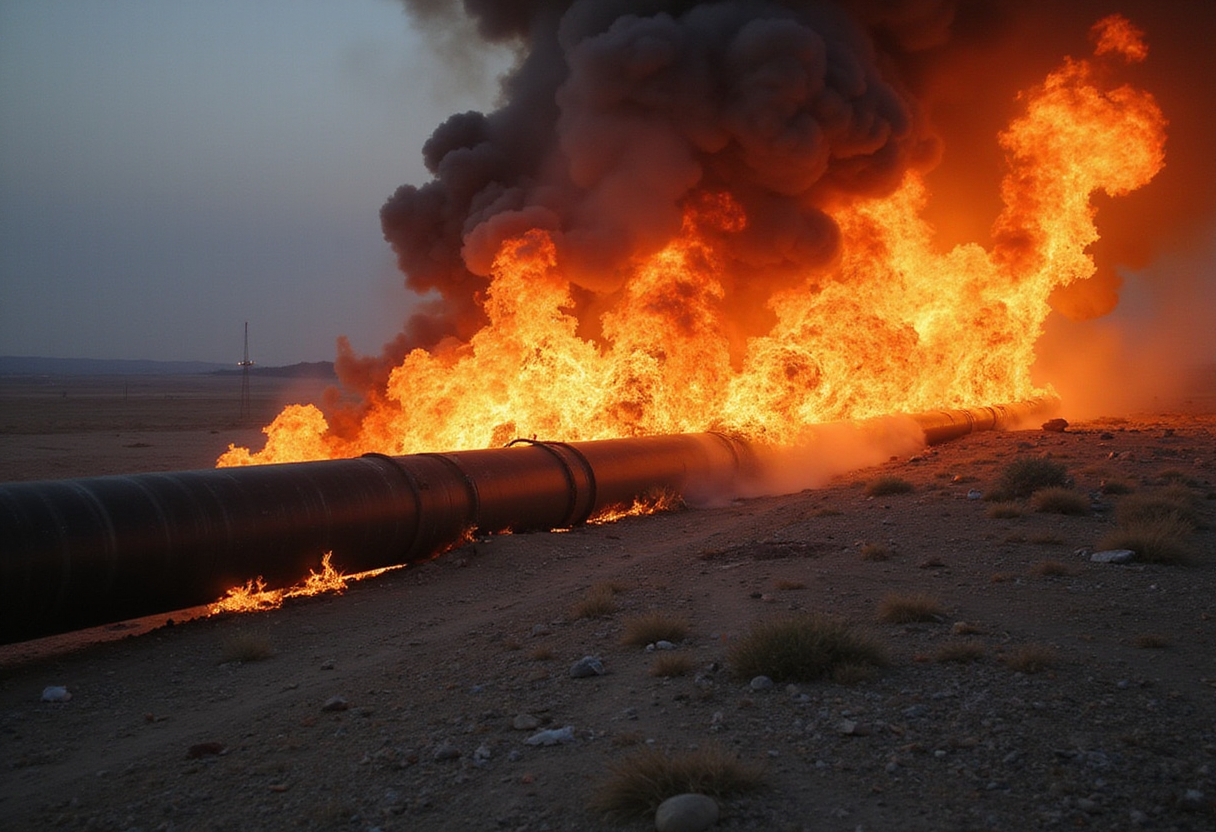
A natural-gas pipeline in Syria caught fire following a blast that the Kurdistan Region news network Rudaw described as "sabotage." The outlet carried the incident as a headline alert; the available report did not name the line, the operator, the time of ignition, or the volumes taken offline.
Which pipeline was hit?
Rudaw did not identify the asset. Syria's gas transmission and gathering network ties production from the Euphrates valley and the Deir ez-Zor corridor to domestic power plants, the country's refining complex at Homs, and — when running — to the Arab Gas Pipeline (AGP) corridor that historically carried gas toward Lebanon, Jordan and Egypt. Without a named facility, downstream effects depend on which link was severed: a domestic feed line would pressure the power grid, while damage to the AGP trunk would affect cross-border volumes only. Rudaw, headquartered in Erbil, has covered energy and security incidents across northeast Syria — the country's main remaining gas-producing region — throughout the conflict.
How should the "sabotage" framing be read?
Energy infrastructure in the country has been a regular target since the start of the civil war in 2011. Strikes against wells, gathering stations and trunk pipelines — by IED, artillery or armed raid — have been reported by wire services and regional outlets through the conflict. Claims of responsibility are typically disputed, with multiple armed actors on Syrian territory. The "sabotage" label in Rudaw's headline reflects the outlet's characterisation; it is not a confirmed determination by an independent authority, and a competing account is likely before the picture firms up.
Supply and refining context
Syrian domestic gas output has contracted sharply from its pre-2011 level, when the country was a net exporter in the region; current output is widely estimated at a fraction of that level. Even a localised pipeline outage can therefore produce disproportionate pressure on power plants operating on constrained feedstock. The Homs refinery complex has historically drawn on associated gas from the same eastern fields, and any sustained disruption tightens its crude diet.
If the line served exports, the AGP's role as a regional transit corridor — and its history of repeated outages and shutdowns since 2011 — frames any restart timeline in practical units of weeks to months rather than days, depending on whether the line was ruptured, damaged at a specific station, or merely depressurised for safety.
The watch items
- Operator identification and the named pipeline or station once disclosed
- Volumes displaced and the forecast duration of the outage
- Any power-generation curtailment or feedstock impact at Homs
- Repair schedule and the security posture at adjacent infrastructure
The Syrian Petroleum Company, where it issues a statement, will be the operative source for capacity and restart data. Until then, the headline stands as an unconfirmed operational incident whose trade-press tally sits on the four watch items above.
via Google News: Pipelines and midstream (Source)
More from Daniel Okafor
Show full bio
Market editor covering consumer brands and retail at Rig & Refinery.
321 articles
Adjoining reports
- Syria Confirms Sabotage Attack on Northeast Transmission Pipeline
- Damaged Pipeline in Northeastern Syria Halts Flow
- Syria blames sabotage for fire on Al-Shola–Deir al-Zour gas pipeline
- Third pipeline sabotage attack hits Syrian oil network in 10 days
- Syria Pipeline Blast Exposes Fragility of Post-War Energy Network